From Central California and Northern England, two aspiring writers natter and share a blog. We like to talk about our disparate but oh-so-similar lives, offer opinions on literature and movies... and endlessly reminisce about Bioware RPG's.


We hope you haven't had enough of our disingenuous assertions. If you have, please don't hit us.
Showing posts with label Book reviews. Show all posts

Thursday, December 16, 2010

Knight's Year of Reading: How LucasArts and BioWare Made More Money Off Of Me

Didn't read as many books as I should've this year, but most of them were definitely quality...and most of them were by Matthew Stover. Don't think I need to go back over just how much I love that guy's books, what they mean to me, etc. Again, I'll say say this: I read SHATTERPOINT and REVENGE OF THE SITH and they inspired me to write two novels (280,000 words total). That's how much.

S'why I'm glad I got the opportunity to read three great books by the Grandmaster this year, and some other great books that I'd happily recommend to anyone. There were a few stinkers, but I'll get to those.

DRAGON AGE: THE STOLEN THRONE
by David Gaider
(3/5 Stars)

Most of the beginning of this year was spent dealing with the aftershocks of BioWare's two major releases, DRAGON AGE: ORIGINS and MASS EFFECT 2. I thoroughly enjoyed ME2, but DA:O might as well have been a religious experience for me, because I could not get enough of it. My way of dealing with all the excitement I was feeling was to buy Lead Writer of DA:O David Gaider's prequel novel, THE STOLEN THRONE.

Buch and I both read this book at the same time, and we were both pleasantly surprised. The lore was greatly expanded upon, Ferelden got a backstory worthy of retelling, and just brought a lot of things together, particularly in the way of Loghain and Maric's relationship. There were some great scenes, but A LOT of battles, some of them tedious to get through. But this was a great book. Can't quite recommend it to anyone who isn't a fan of DA, but there ya go.


STAR WARS: TRAITOR
by Matthew Stover
(5/5 Stars)

I had put off reading this one since it's technically the thirteenth book in a the NEW JEDI ORDER series. I felt some obligation to read the other books, but I'm glad I finally talked myself into picking it up. Wow. This isn't so much a Star Wars novel than it is an experience. Jacen Solo's trials in the Embrace of Pain are some of the most chilling scenes I've read in a book. Not only that, but it posed a few philosophical questions that really just rocked my universe.

I really recommend this book. Yes, it's the thirteenth book in a series, but there are only a few things that might make you scratch your head if you're not familiar with the timeline. This story is worth dealing those brief moments of bewilderment.


STAR WARS: LUKE SKYWALKER AND THE SHADOWS OF MINDOR
by MATTHEW STOVER
(5/5 Stars)

Every time I read a Stover book, there's that moment afterward where I just feel like he's written my favorite book. This is a book where Stover really takes advantage of that blank slate in the post-OT canon between RETURN OF THE JEDI and HEIR TO THE EMPIRE and exploits it for all its worth. It revolves around the Battle of Mindor, the incident that persuaded Luke to resign his title as General. Let me tell you, he did have his reasons.

This is one of the first books that really does its part in referencing the Prequel Trilogy, making the timeline more cohesive, bringing many threads together. Not only that, but Stover really celebrates what made the OT great, giving his own point of view on the nature of myths themselves along the way. This is one of my favorite books, if not my current favorite, specifically because there are so many layers to peel back here and examine.

People might be thrown off by the cheesy dialogue/narrative through the first part of the book, but...you know...that's Star Wars, and Stover does all he can to show you what you've been missing. Fraking love this book. Praying for a sequel.


STAR WARS: HEIR TO THE EMPIRE
by Timothy Zahn
(4/5 Stars)

The importance of the Thrawn Trilogy can't be understated. Zahn's books essentially created the Expanded Universe and guided the direction where these stories would continue on in the two decades since its publication. I'm not overhyping it, either. These are quality books. All of your favorite from the Original Trilogy are here, and they are perfectly characterized. And the adventure is true Star Wars.

Not to mention Thrawn, who is probably one of the best villains ever, in any medium. The reason I can't give this book 5 stars is because...well...you cannot read this book without reading the other two. You just can't. Look at this as 1/3rd of a bigger book, because that's essentially what it is.


STAR WARS: DARK FORCE RISING
by Timothy Zahn
(4/5 Stars)

Again...wow. This is a great story, and it continues on very well here, with a lot of twists and turns along the way. There's not much I can say without spoiling the story, but this continues the story of Luke and the Gang as they try and outmaneuver and outwit Grand Admiral Thrawn, and this is not an easy task. Great sequel but, once again, this is the second part of a larger story. THE LAST COMMAND is the last book, but I'm still making my way through it currently. Hopefully, I'll have it read soon!


THE BLACK PRISM
by Brent Weeks
(2/5 Stars)

Brent Weeks is a great person, and a great writer when he wants to be. It just really seems like he cranked this out really quickly, though, because it doesn't have the polish or depth that a fantasy novel of this size should. People who have read his NIGHT ANGEL TRILOGY will notice similarities in characterization, dialogue, and even story.

He's mentioned GRRM's books several times as his inspiration, and it definitely seems as though Mr. Weeks is trying to emulate him in terms of scope, multiple POVs, and really just being a dick to his characters. But Brent really shines when he sticks to one character, which is why I loved THE WAY OF SHADOWS as much as I did. When he tries introducing so many characters, so many bits of information, and so many conflicts at once...he loses me, and he lost me big time here. Don't think I'll be buying the second book in this series, unfortunately.


TEST OF METAL: A PLANESWALKER NOVEL
by Matthew Stover
(5/5 Stars)

After giving THE BLACK PRISM a try and not really caring for it, I almost thought there was something wrong with me. I thought maybe there was something about the fantasy genre that just wasn't gelling with me anymore. That instantly changed when I started reading this book. It reminded me why I've been sticking with this genre for so long, and why I'm glad that I have.

I didn't know anything about M:TG lore when I started reading this, but you really don't have to. I was very rarely lost, but you do benefit from knowing some of the events that occurred in the previous book, AGENTS OF ARTIFICE. Still, ToM is a fantastic, mind-bending read. Stover handles the concept of a multiverse with all the subtlety of an astrophysics professor on crack, mercilessly introducing you to concepts that will make your head hurt for long periods of time afterward. Don't even get me started on the fight scene that takes you forward, backward, and SIDEWAYS through time. God...

I'm going to have to fiercely recommend this book to anyone who likes to be mentally stimulated. You might just learn a few things about life, the universe, and everything in the process.


OLD MAN'S WAR
by John Scalzi
(4/5 Stars)

This is the best science fiction novel that I've read in a very long time. Deep, yet subtle. Grand, yet simplistic in its presentation. Scalzi tells the story of John Perry, an elderly man who has just turned 75, and has also just joined the military branch of a mysterious organization. After wandering in ignorance for some time, Perry finds himself with a new, combat-ready body, and in the middle of a horrendous intergalactic conflict.

Scalzi channels the classics of the genre, all the while weaving together a great story that doesn't overstay its welcome. In fact, it seems to check out before dinner is served, which is one of the only detracting factors of this novel; it ends far too quickly, it's almost surprising! I'm currently making my way through the sequel, THE GHOST BRIGADES and loving it. If you haven't given this a try, I really must insist that you do!


That's pretty much it! There are plenty (a ton) of other books that I tried and failed to read this year, but I don't really want to talk about them. Maybe later.

Here's what I'm going to be attempting next year!

-WISE MAN'S FEAR by Patrick Rothfuss

-HIS FATHER'S FIST by Matthew Stover (Still gotta read the rest of the series. Some fan I am.)

-Any other Stover releases afterward.

-THE COUNT OF MONTE CRISTO by Alexandre Dumas (Seriously, this thing's huge.}

-STAR WARS: THE LAST COMMAND by Timothy Zahn

-THE LAST COLONY by John Scalzi

-SHADOW'S SON by John Sprunk

-THE EYE OF THE WORLD by Robert Jordan

-Any Dragon Age novels that should be released. You know there will be.

Monday, June 21, 2010

Authors are filthy, lying bastards (Crs Buchanan's classic tale of lost love and discovery)


Three years ago (it might have been four) my girlfriend-at-the-time Wendy gave me a copy of The Princess Bride as a birthday present. She inscribed it 'to my Princess Bride' in an attempt to piss me off, and it absolutely worked. She also threatened to send me flowers - secretly I wished she had ;)
I love flowers.

I'd never read the book - I was only a little bit aware of the film but didn't know anything about that either. The novel had a long introduction, where author William Goldman told the fascinating story of how S. Morgenstern's classic (and very long) novel 'The Princess Bride' had changed his life. He explained immediately that this novel was not his own work, but an abridged version of Morgenstern's masterpiece. This introduction went on and on, detailing how the book helped him grow to find his talent as an author, and about sharing it with his family. He wrote at length about the process of adapting the old text, filming it as a movie, and the legal trouble he had had with the late Mr Morgenstern's estate. If it hadn't been a gift from a girl I was absolutely crazy about, I might have given up, confused and wondering what the point was. (I like to think I have more patience now, due in no small part to Wendy.)


There was one tiny thing that confused me - he kept talking about the European country 'Florin', where it was supposedly written, as well as set. I live in Europe, and I'd never heard of any nation going by that name... though I was familiar with the coin. Aha! I thought, about a third of the way into into it. This is rubbish. It's an in-joke. There was no S. Morgernstern - Goldman was playing with my head, and apparently just because he thought it was funny. The way he did this, and the little obvious-lies that tipped me off, made me laugh, and suddenly I couldn't put this big intro down. I wanted to beat him, by figuring out what bits were false and what bits were true. I called up Wendy and thanked her for the gift, telling her how much fun I was having before the story had even begun.

By the end of the intro, I had it all figured out. The part about his teacher, that was true. The part about S. Morgenstern's book inspiring him were not. The part about being tempted by a Hollywood actress was false, but the part about his strained relationship with his wife and fat son - that was so brutally honest and touching, it had to be true.

I looked him up afterwards, only to discover that every single word was fiction - there for no reason other than setting up the hilarious pretend-annotations he included in every chapter. I kept imagining Goldman laughing at me for feeling bad for the son he never had, empathising with his pretend adoration of his pretend wife - and it made the book ten times better.

Later, when I saw the film version with Wendy (she had watched it plenty of times as a kid and wondered what I, the big reader, would think of the movie), I was really disappointed. For one thing, almost none of the characters were how I imagined them (Cary Elwes, you don't count - you NAILED it, sir) the story was different in places, and Peter Falk kept interrupting, talking to the kid from The Wonder Years about the plot.

The movie missed out on the best part of the book - unlike the brilliant novel, never once did it actually try to fool you. It was a story-in-a-story... kinda... but an obvious one. Peter Falk wasn't lying, he was acting. And thus, his scenes seemed pointless to me: a pale, meaningless imitation of Goldman's glorious tall tales and disingenuous assertions.

Tell you what though - that movie has a killer music score. I like the film, by the way - it's just that the novel is a million times better, primarily because of the lie.

***


At the moment I'm reading Wm (I think that means William - what's with these lying Williams?) Paul Young's novel, The Shack. Beneath the title it says, 'Where tragedy confronts eternity' - which made me chuckle because it sounds a bit like it's going to be a long, hard read.

This is a very famous 'Christian book'
about a man who spends a weekend talking to God. Every review or quote listed on the jacket or inside talks about how faith-affirming it is, and not one actually mentions its quality as a novel. Fair enough - it's a book with a message, and the fans like it not for its quality, but for what it represents. No problem. I like a lot of really bad 'gay movies' because of their tacked-on pro-equality messages, so I can appreciate where the Christian reviewers are coming from here. Curious, I decided to give it a read and see for myself. For once, I wasn't setting out to criticise, just to see what the fuss was about. And, honestly, as a one-time Christian myself, I wanted to see if this sensationally-popular first novel would have any effect on my own views.

I'm about half-way in at the moment, so I'm not reviewing it here. So far it seems fine, maybe slightly below average, but I haven't finished it so what do I know.


I mention it because it begins with an introduction by Young, explaining how the protagonist, Mackenzie 'Mack' Allen Philips, is a close friend of his and how everything that happened is accurate, as far as he and Mack can remember it. Oh! I thought, like a sucker, my three-year old warning system failing to spark enough synapses to get through the accumulated dust. This is actually true? A guy really claimed to have spent a weekend with God, and this is more-or less his own account? Well, this I gotta see. No wonder it's done so much to affirm people's faiths. Imagine if it really happened...

And I started reading, and enjoyed it quite a bit. The quality of the actual writing is sometimes not great - and the author has a real tendency to lapse into All-American hugs-and-prayers cheesy bullshit (in particular there is a scene where Mr Young actually casts himself as Mack's wise, friendly and all-around awesome best friend, who does everything he can to help the guy out. It's actually pretty funny how cool he makes himself sound.)
But - I was enjoying the book and the writing plenty, despite flaws. (No author is without jarring flaws that seem obvious to everyone but him.)

The plot has problems too - in that it seems very stock and unoriginal, in parts. I don't think I'm giving anything away by mentioning that Mack's daughter is kidnapped and presumably killed early on - and there are to chapters detailing the experience. Throughout these I kept thinking that the section of the story was rather unoriginal and dull. But - how could I fault the author for that? This is what really happened, after all - as accurate as he could write it with memory - and honestly, how could I pick the chapter apart when it detailed the actual kidnapping of an actual little girl? I'm a sarcastic git, but not a monster.

Well, obviously... as you'll have guessed if you didn't know... there is no Mack. The book is pure fiction, though details are based around the author's own life and maybe even his wife's personality is in there too - just like every book ever. Whereas this same trick enthralled me when William Goldman did it, this time I just don't see the point!
Even in the Blair Witch Project, the fake true story helped to make it scarier. What does this achieve - trick you into finding it more moving? That's cheating, Wm.

The Da Vinci Code was full of lies, too. At the beginning there is the now-famous 'FACT' page, which is just a list of all-but-proven hoaxes and speculative opinions, all of which are twisted beyond recognition to serve the (really thrilling) plot later.

Suddenly The Shack doesn't seem as good. I'm still enjoying it, but what was a harrowing, painful-to-read kidnapping is now a formulaic, by-the-numbers book plot. What was an author making himself look good in an unavoidable cameo is now... just really silly.

Fooled yet again.

**

I'm not sure what my point is in this article. But it's interesting how the two books sparked such different reactions in me with the same trick. I guess when a comedian tells you a lie and winks as he does, it's different.
Now I could be wrong here - I could be doing Young a great disservice. Again, I haven't finished it yet, so I'll reserve judgement. I have more patience now - thanks Wendy. I wish I could have shared this story with you too.

Next I'm going to read A Study in Scarlet by one John Hamish Watson. I read the first couple of chapters last week and I'm amazed by the central character, once again an old friend of the author. Can't believe this guy, man. Also there is a new videogame about the time he caught Jack the Ripper, which I will be playing later. I didn't even know that Jack was eventually caught!

I think from now on I'll stick to true-stories that are actually true. I'm sick of being made to look a fool.


** n.b. All the details in this blog entry about myself and my life are false. **

Sunday, June 6, 2010

Going on about 'Good Omens', Terry Pratchett, Neil Gaiman, Tori Amos


I don't really have anything to write about today, but I feel like it's been a while since I've posted here and I just got a new programme that makes my keyboard sound like a typewriter! And it's really therapeutic. So - I'm going to use this blog like a diary and just talk.
The last few days I've been reading 'Good Omens' by Terry Pratchett and Neil Gaiman. At about halfway through, I'm absolutely loving the book. It was recommended by the nice lady at The Critical Fiction Den - and thank goodness because otherwise I probably wouldn't have bothered (more on that later). But I'm getting that feeling of pure enjoyment from a book now - I rarely get this - when every chapter is perfect, and you carry the thing around with you at all times. I've been reading this in bed, in company, in the car (parked), whilst walking, crossing roads, listening to Best of Queen tapes... last night I dreamed that I was at a party in my honour, and met a girl... and carried on reading 'Good Omens' at a table in the corner.

It's dry, dark humour, nothing all that special in its style or plot - but just very very funny jokes and sardonic observations. I think it's just perfectly tailored to my tastes.

I say I normally wouldn't have read it because of the authors - I hate to criticise Terry Pratchett because he's living my dream, and he's a role model for me. A humble, pleasant, hugely talented British author - and more than that, one whose author photograph has genuinely shaped my life and ambitions. I got a copy of 'The Colour of Magic' at high school and looked at him with the big black hat and the beard and leather jacket... with a description full of self-depricating humour and 'lives behind a keyboard' and thought, 'that's what I want!' Now I'm bearded, typing comedy and SF/fantasy, and I still haven't been able to throw away my big, black hat. I don't wear it in public anymore, but it's still here.
But... I didn't particularly enjoy 'The Colour of Magic' at school. A few weeks ago I found it again, and had another go. (Largely because of 'Luke Skywalker and the Shadows of Mindor') I only got a few chapters in before getting bored. I dunno... it's clearly a very good book, I daren't say I didn't like it, but maybe it's his style. Or maybe I'm an uncultred Nintendo-generation git with no attention span. I still find the book very hard to follow, and the characters very hard to care about.


As for Neil Gaiman (no cartoons for him, he's too handsome) my experience is a little better, but much more recent. I became aware of him by listening to Tori Amos records (I believe the two of them are good friends, as she mentions him sometimes in her lyrics). I knew only that he was Amos' mate, and he wrote very successful graphic novels. And graphic novels made me feel uneasy. I'll tell you something else, I hate that term. They're not novels, people. I can see why you wouldn't feel the term 'comic books' is appropriate, but they're sure as hell not novels.
Anyway, I did eventually watch some films based on his work - 'Mirrormask' (which I liked) 'Stardust' (which I really didn't like) and 'Coraline' (which was amazing). Early this year I read the children's book Coraline and liked it too... and started hating how Americanised the movie was! I bought a copy of 'American Gods' but so far it's just been sat on the shelf, looking large and intimidating, whispering in a sickly voice about graphic novels and Tori Amos pretentiously standing up to play piano. *
After this, I will have to find time to give it a go. And maybe even 'The Colour of Magic' again, too.
This book by the both of them is just brilliant. I don't know if they were both having a good day, or if they just compliment each other perfectly, or what. But this book just seems flawless to me. The experience of reading it is pure fun - no boredom, no confusion, nothing bad to say about it. Not one thing... so far. Just a very funny book about an angel and a demon and the antichrist and the horsepersons of the apocalypse, that I can't put down. I haven't felt this way since 'The Princess Bride', or the last half of 'Ender's Game' (after the Giant's Game was introduced and I let myself enjoy it).

* I do find her pretentious, but Tori Amos is amazing. Amazing. I don't know much about music, but I really, really love her albums.
It;s jsut that need my performers and artists to be humble - once they start wearing sunglasses or big hats, like Duncan Banatyne I'm out. Tori Amos is one of those who is just so good that I don't even mind her showing off and talking rubbish.
I should do another blog about her, but now I have to go to work. I really like to think of her as a 'musical poet' rather than a musician. The music is fantastic, don't get me wrong, but her lyrics are really inspired. I have so many favourites.

Here's one which I... think is about Mary Magdalene? If so, it's damn good!

http://www.youtube.com/watch?v=nyoVrbcgbO4&feature=related

Saturday, May 15, 2010

Book Review: The Crystal Shard by R.A. Salvatore


I had never read a single work of fantasy before I first read The Crystal Shard three years ago (unless you count Harry Potter, which I wouldn't). It all just didn't make sense to me. My mind could not wrap itself around a genre in which magic and elves were the norm. It could not. My friend had been pressuring me to read R.A. Salvatore's books for years and years and I always refused. But one day, I was leaving to stay at my uncle's cabin for a few days and I didn't have much to take with me as a means of entertainment. So I reluctantly took along my friend's old first edition TSR copy of The Crystal Shard.

With everyone asleep and my back to the fireplace, I started reading: and I didn't stop until my eyes were almost completely dried out and tired. Every night, all I did was read that book: the introduction of the drow, Drizzt Do'Urden, sprinting across the tundra of Icewind Dale; the halfling, Regis, carving scrimshaw on the shores of a lake near Lonelywood; Bruenor Battlehammer's crafting of the legendary weapon, Aegis-Fang. All of it was burned into my mind, followed me all the way back home, and invaded my waking thoughts long after I had finished the book. I could not forget what I had read for the life of me. I read the next two books in the trilogy, Streams of Silver and The Halfling's Gem, later that week.

This book, as well as the rest of this trilogy, is so important to me that I'm STILL afraid to read the rest of the series for fear that the story will lose that magic, and I never want that to happen. The Crystal Shard delivers on every promise that its opening poem holds. The characters are unforgettable and unique as they are quirky. The action is fast and wonderfully detailed, which Salvatore is very much known for these days, thanks to his work as a bouncer. The story is good, as well, revolving around a weak almost-mage who happens upon a powerful relic that grants the wretch almost anything he wants in the world, which happens to involve the destruction of the Ten-Towns of Icewind Dale. It's then up to the four friends, Drizzt, Bruenor, Regis, and Wulfgar, to stop him.

Looking back on it three years later, it's not hard for me to see why this series has so many outspoken detractors. There are cliches abound in this debut entry, I won't lie. This was written by a man who must have loved Tolkien as much as I love these books. But, to me, Salvatore is one of the few authors who understand the spirit of fantasy stories: high adventure and how friendship can conquer even the worst of demons. It's the reason why people STILL play D&D, and why World of Warcraft is an international phenomenon, the thought that ordinary people can do fantastic things worthy of legend. To me, Drizzt and the gang are definitely worthy of such status.

I've read a few authors who will say, "Yeah, I read those Forgotten Realm stories, but I moved on." To hell with them, says I. Personally, I don't think I'll ever be able to move on, not until death. Even after all the fantasy novels I've read since, that feeling of pure engagement with this story and its characters that I had will likely never be matched. I still see those four adventurers departing Icewind Dale, taking their first steps on their journey to find the Mithral Hall, and even after three years I'm still running to catch up.

The Crystal Shard
Amazon.com|Amazon.co.uk|Book Depository

The Icewind Dale Trilogy
(includes: The Crystal Shard, Streams of Silver, and The Halfling's Gem)
Amazon.com|Amazon.co.uk|Book Depository

Thursday, May 13, 2010

Book Review: Star Wars: Traitor by Matthew Stover

Okay, so I remember when Mister Buch first recommended Star Wars: Shatterpoint to me, and I remember what I was thinking: Star Wars books are obviously a silly concept. I had been talking about Heart of Darkness for some reason when he more or less said, "Hey, you know this one Star Wars book was sorta inspired by Heart of Darkness. Also, I am British." I nodded a bit, confused by such a concept. It actually sounded like a good idea.

I totally impulse-bought the book the next day, I think. Before I started, I was a little uneasy reading about Mace Windu of all people: the Jedi who almost did a lot of things. So, I start reading. The intro of the book drags on. We get a very long Apocalypse Now scene that goes on forever and almost convinces me to put the book down. Such exposition grates on me like some sort of device used for grating cheese...whatever those could be called. (wink)

But! I didn't stop there. I kept going, well into the book, past the part where Mace Windu flips someone off and where he uses his lightsaber to perform brain surgery. I sorta skipped around the giant battle near the end, which took up so much space and had none of the great pacing or development that had taken up every sentence of the past 300 pages, and made my way to the back cover. Wow. That was amazing, I thought. That was like...Wow.

Jedi can do that? STAR WARS can do that?! Was this insane wordsmith, Matthew Stover, allowed to do any of this? Wow.

Star Wars seemed so much deeper, so vibrant, alive. Plausible. No longer was it being communicated to me through rose-colored glasses, through the words of authors who wanted nothing more than to retell a story the way the movies would have, or to show good triumphing over evil, Jedi over Sith, so on. Stover showed me that he could do all of that if he wanted to, but that would be a lie - and the truth.

Basically, shit got real.

I read his novelization of Revenge of the Sith afterward, also by Buch's recommendation, and absolutely adored it. For one, he didn't drag on at all except for two parts, if I remember correctly. The opening battle was very long, but I got into it after awhile, but the second battle over Utapau was daunting as hell. But even with that, I still loved that book. Why? Because I loved Episode III a lot, but it fell just short of my expectations. It's like Stover knew what I wanted out of that movie and wrote the book accordingly. To him, everyone matters. People like Count Dooku aren't evil for the sake of evil, they have motive. Similarly, Anakin's fall makes much more sense this time around; it wasn't just predicated on his love for Padme, it was on account of the expectations that had been thrust upon him, the power that he knew he had, and didn't have. It felt real. I could understand it all, fully.

Also, Palpatine was just an amazing character, as well. He, too, had motive.

After those two, it was awhile before I read another Stover book. I was just in awe. I hadn't been so excited about reading since R.A. Salvatore's Icewind Dale Trilogy or Ender's Game or Foundation. Not only are Stover's books well-written, they have this gravitas about them that makes them properly dramatic. Makes them a proper Space Opera, and almost gives me an image that all of his stories are happening on a stage, complete with a Master of Ceremonies who hops up on stage to set the tone.

Then I read Heroes Die and I sorta stopped caring as much. As I've said, I liked it more for the concept, which was totally up my MMO loving alley. But the thing kept going on and on and on about little, insignificant things. Though there was a good story in there, all the little flaws that were present in his Star Wars books that weren't very noticeable took center stage here. My friend read the book, loved it more than I did, but agreed that the exposition got in the way a lot.

Stover's strength is in his characters and how real they are. And even if you can't sympathize with them, you KNOW who they are. You understand them, and that's where the real drama of his stories come. Like I said, one of the most heartbreaking things I've ever read was seeing Mace Windu realize that all that he's ever been just was not enough to overcome the jungle.

I've had another one of his Star Wars books, Traitor, sitting on my shelf for a long time. The reason for the hesitation: I was still kind of at odd with what I read in Heroes Die and I had promptly forgotten the reasons I loved Stover's books in the first place (not on account of the book, it had just been a long time since I've read them). Also, Traitor is Book 13 in a really long series of books called The New Jedi Order. Who picks up a book so late in the series and starts reading? I do, I guess.

I've read books from the Old Republic and some from the Clone Wars, but I hadn't read any that took place during the New Republic. I was hesitant; I wasn't quite sure how reading about characters I had come to love on screen would work. Thankfully, I didn't need to find out, because this book revolves around a character I had only heard about, never read about: Jacen Solo: twin brother of Jaina, son of Han and Leia Organa Solo. Interesting.

The book, in short, is amazing. Again, it's hard for me to believe that this is actually a Star Wars book. I came to love Jacen Solo as a character and really feel for him as he went through his various tortures, which are crazy to read. The action is top notch and as bloody as Stover was probably allowed to make it. The dialogue is real, witty, and emotional at times. There was one moment where I very nearly teared up, something I'm not sure a book has been able to do to me yet. And even though this is Book 13, I was very rarely lost in what was going on. All that you MUST know is that the New Republic has been fighting an alien race for control of the galaxy: no big surprise there, huh?

This is one of the best books I've ever read. Stuff like this just speaks to me, and I enjoy it when an author like Stover has something to say and not just write. This thing talks about fundamentalism, tradition, the frail divide between good and evil, the true nature of the Force, and how being yourself is paramount to all else in life, and can even land your actions on the list of most epic scenes ever created within the Star Wars universe (which I won't spoil here, and yes, that's a real list).

This book is on my shelf, and there it will stay. I am proud to have read this and infinitely glad that Buch suggested Stover's works to me. Everything he does inspires me in some way: his honesty, tenacity, and his liberal usage of words like fuck and/or shit. He still remains one of my inspirations, and this book has sealed his fate as such.

I'm off to buy the next/last Star Wars book he wrote, Luke Skywalker and the Shadows of Mindor. Reviewers have been tough on him for this entry, but I have a good feeling that it won't disappoint. In any case, I'm really not sure how he could top himself with Traitor. He has two more books coming out this year, both of which I'll list here, both of which I'll be buying.

/end ass-kissing

Star Wars: Traitor
Amazon.com|Amazon.co.uk|Book Depository

God of War (co-authored with Robert E. Vardeman)
Amazon.com|Amazon.co.uk|Book Depository

Test of Metal: A Planeswalker Novel (Magic the Gathering)
Amazon.com|Amazon.co.uk|Book Depository

Friday, April 2, 2010

(Still) remembering Red Dwarf


I felt like writing something personal, so I thought I would talk about the huge impact Red Dwarf had on me, as a writer and in general.

If you're not familiar with the franchise, it's a British sitcom (and four comedy novels) set in space. It's a simple sitcom set-up about 'four or five people who don't get on having to live together' but which also satirises and/or pays loving tribute to all manner of space operas and science-fiction classics. The premise is simple - an amiable slob awakes after three million years of suspended animation in the middle of black, empty space. There are no aliens and no advanced civilisation. For company he has a hologram resurrection of the crewman he hated most, a creature who has evolved from cats, a senile old computer and a fussy, subservient robot.

From 1989 to 2000 they had a series of sitcom-style misadventures, and Star Trek-style adventures, all with perfect characterisation, a wonderfully dark and witty sense of humour, and fascinating storylines. I always think of it as 'Blackadder in space'. And I could spend the day writing an introduction to it!

I'm a big fan, and I'm amazed it's never come up on this blog until now. As a teenager, I watched my carefully-collected videos of this show religiously, believing every line to be flawless and the actors to be the finest comic talents on Earth. When I got older I started to see the flaws and grow tired of the well-worn tapes, but I can still remember most of the lines in the first seven series!

But one part of the franchise that remains at the highest in my estimation is the books. Beginning quite early on in the show's run, the two writers, Rob Grant and Doug Naylor (this was back in the day when British TV shows ran for six episodes a year and were written by only two people) began working on a series of Red Dwarf novels. Rather than write a spin-off or simply novelise the shows, Grant and Naylor (using the pen-name Grant Naylor) decided to begin anew, so that they were writing two seperate versions of the story at once - the TV version focused on jokes and brief adventures, and the novels' version was more dramatic and epic.

The novels Red Dwarf (AKA Infinity Welcomes Careful Drivers) and Better Than Life are genuinely brilliant sci-fi comedy. Much like Terry Pratchett or Douglas Adams, but... maybe this is me... so much better! So much deeper, funnier and more engaging.

Then came the great divide, where my heroes Grant and Naylor had a personal argument of some sort, and split for good. It was like watching my parents divorce. Grant went on to write excellent comedy novels and Naylor continued Red Dwarf, but not very well. Despite bold new ideas and characters, the show never quite recovered. It teetered away and ended on a whimper and a false 'to be continued' (well there was the recent 'Back to Earth' special, but that's another story.)

And it killed me that the show never had an ending. Now I would never know - does Lister find his way home? Do Lister and Kochanski finally fall in love? What becomes of Rimmer after his brave departure? It sounds very silly, but it took years for me to accept that I'd never know.

---

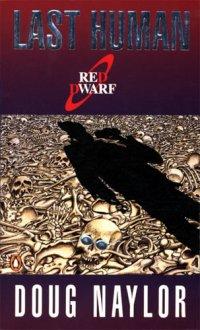
But, I distinctly remember a wonderful moment, when I was reading the last chapter of Last Human by Doug Naylor.

---

See, after the split, both authors wrote one more Red Dwarf book - each of them contradicting and disregarding the other, and each a direct sequel to Better Than Life. Now my divorced parents were asking me to choose which one I loved most. At high school I wrote a novel-length fanfiction which feebly attempted to bring the storylines into one.

Grant wrote Backwards, which took a very dark turn, but evolved to become extremely witty and with deeper characters than ever before. As well, it was a thrilling, scary adventure with brilliant science fiction in the first half (on 'Backwards Earth'). Best of all it included a massive, dramatic expansion of my favourite side-character, 'Ace Rimmer' - the dashing alter-ego of Rimmer with his legendary catchphrase, 'Smoke me a kipper, I'll be back for breakfast!'

And Naylor wrote Last Human - much more the traditional style, but with a tight, excellent space opera plot, great gags and...

... an ending.

In the final chapters of the book, Lister and Kochanski are in love, together and perfectly happy. They never made it to Earth (well they kinda did) but that's all part of the climax. All of the transformations and journeys that began in Red Dwarf and the first episode of the series come to an action-packed and fantastic conclusion, and there is nary a joke in sight. The third act of Last Human is what dreams are made of.
And though there is no Ace Rimmer, the real Rimmer brings his story arc to a close, by fathering a son and becoming the hero we'd wanted him to be since we grew to love him in episode 6.
And as he sacrifices himself to save his son and his crewmates, Rimmer sends a message in Morse code - S.M.A.K.I.B.B.F.B. Get it? It's an allusion to a character who never even appeared in this book's time-line, but that's what makes it so powerful.

I cried! I cried tears of joy that the dearest fictional character I'd ever read had finally become what I wanted him to be. I'm not saying that I prefer the Naylor book to the Grant book (don't make me choose, mum and dad!), but it left a powerful emotional effect on me.

And I re-read that book over, and over, and over again. I remember the third or fourth time I reached that ending, that perfect last chapter, and thinking, "This is what I want to do. I want to write stories with jokes and rich characters, and I want people to feel like I do now, just because of printed words. And I want to keep trying to write a book as good as this, but never make it! That'll keep me trying"

I've been through various odd phases in my life since then, but I'm never happier than when I write fiction, hear great comedy or find myself unexpectedly moved by something. Red Dwarf taught me 75% of what I know about writing, and completely shaped my sense of humour. Rimmer gave me an attitude, The Cat gave me a sense of childlike wonder, Kryten gave me too much self-deprication, and all of them have effected my strange accent. Lister gave me a laugh, some ideals, some beliefs and a hopelessly romantic soul.

Now I even like to imagine parallels between 'Buch and Knight' and Grant and Naylor!
Last year I got a tattoo of the Morse code for 'SMAKIBBFB' on my left arm. I'm not a tattoo kind of guy, but it's to remind me of my goal as I write. I can see it in the corner of my eye when I type. Like those books and some of the classic episodes, it never fails to inspire me.

The final line of Last Human never left my head. I keep wondering about featuring the line at the very beginning of one of my own stories. It would have to be a special one!

Slowly, gently, almost impercebtibly, the grass began to sway.

Monday, March 15, 2010

'Life of Pi' and muttering


I haven't been writing much lately - and hardly at all here on the blog.

I've had a lot of hours at work, and been busy with other, secretive things and applying to University.

I just recieved official confirmation of my application through the post. With any luck, and a successful interview, and a succefful application for a loan, I will be studying English and Creative Writing in September!

Assuming I will get in... I've ordered a stack of books, so I can be a little more 'well-read' by the time it starts. There are some classics in there, some modern hits that I think I 'ought' to have read, and some that randomly took my fancy (and some indulgences, i.e. Mass Effect.)

I want to get a good chunk of them read before the end of summer. I'm picturing a summer of working hard, saving money, and reading in parks, beneath trees! I even bought a nice cushion so I can read in bed. That's commitment!

Anyway, this is a huge deal for me. Finally getting a worthwhile occupation (well, kind of?) and in three years a good qualification. And it's in a subject I really, completely love, so I think these three years will be a lot of fun. I will post updates to this.

--
--

Also I just finished reading 'Life of Pi' by Yann Martel. It won the Booker Prize in 2003, and came highly recommended by a friend, who I've often disagreed with in the past. But I absolutely loved it.

It is, essentially, an ordinary castaway story, focusing on one single character. But that character is so beautifully written and realistic and so interesting to read, and there is a unique spin on the story in the form of a Royal Begal tiger (and a giraffe and a hyena, and an orangutan) that share the lifeboat with him. And there are some surprises at the end... well I certainly didn't see them coming... which are just wonderful. I read the last few chapters with my mouth wide open, willing my brain to process the words faster so I could find out more.

There isn't a great deal of plot here - it's a book about Pi himself, and more quietly about religious faith vs scientific 'reason'. I love character studies, and well-rounded, deep, interesting voices. This is full of that. And the deepening layers of fictional 'narration' passing themselves of as fact work to suck you in and make you believe in Pi all the more.

Here is a wonderful passage from the book:

I can well imagine an atheist's last words: "White, white! L-L-Love! My God!" - and the deathbed leap of faith. Whereas the agnostic, if he stays true to his reasonable self, if he stays beholden to dry, yeastless factuality, might try to explain the warm light bathing him by saying, "Possibly a f-f-failing oxygenation of the b-b-brain," and to the very end, lack imagination and miss the better story.

Sunday, March 7, 2010

Book Review: Dragon Age: The Stolen Throne by David Gaider


(Review originally posted on Amazon.com: link)

Books like this present a tremendous opportunity to allow the gaming faithful of Bioware's lore-rich I.P.'s to feel closer to the company's stories. I picked up this book after falling in love with Dragon Age: Origins. Its story, the characters, and its push to make your experience feel unique and personal pretty much ensured that I would be throwing more money in Bioware's direction. So, here we are.

But did DRAGON AGE's Lead Writer, David Gaider, succeed in making me believe that THE STOLEN THRONE was an extension of the game I just played? Well...kinda.

Taking place many decades before Duncan inducts you into the Grey Wardens, THE STOLEN THRONE recounts the Ferelden uprising against its enemy occupants, by way of a rebellion led by Alistair's father, Prince Maric. It takes you through the various clashes of the two armies, as well as the constant political head-butting Maric must endure as question about his competence as a leader comes into question.

But those who played DRAGON AGE will likely be more interested in the friendship that is struck between young Maric and Loghain, the man who would later betray the throne. It begins as a bond of necessity in the wake of enemy armies closing in to cut down Maric as the last true heir to the throne, but it slowly evolves into a true connection that quite literally comes to shape the very future of the country they're attempting to save.

It is a bit surreal to read about some of the characters that later resurface in the video game, since as the Grey Warden, you will literally hold their lives in your hands. This almost made it feel like it was working up to YOUR story at times, but it only gets a little close and doesn't seal the deal. This story, in the end, actually feels very separate from whatever shenanigans you get into later in DRAGON AGE: ORIGINS, but that didn't really detract from the read...other things did.

Just like Bioware's other Lead Writer, Drew Karpyshyn, David Gaider's prose has a habit of diving into chapters of expository monologues. This, as I've said before, does not make sense to me. These are writers who have had awards thrown at them for their dialogue; why they insist on keeping their characters quiet for extended lengths of time is beyond me. What made DRAGON AGE great were those moments where the characters really bared their souls, but there isn't much of that to be found here (until maybe the last 100 pages or so).

There was just battle after battle, which made me yearn for a story of a smaller scale in this universe, where the characters could have more room to breathe. Not every story in the fantasy genre has to be about kings and massive battles to be successful.

Despite all of this, I did have a great time reading this book, and it certainly didn't put me off enough to discourage me from reading its sequel (though it does make me wary). It's by far the best book to have come from Bioware's writers. The ending is satisfying, though it ends rather abruptly. The characters are well-conceived and fleshed out, but those who have played DRAGON AGE will already have an idea of how this story unfolds.

But I'm still waiting for a book from Bioware that allows its readers to invest just as much emotion into its story and characters as they're able to do with their video games. A story that's interesting in its own right, but feels as though when it comes to an end, your story begins.

Score: 3 1/2 out of 5 - For giving flesh and bones to the lore of Dragon Age, but opting out of creating a story of a more intimate manner.

Friday, March 5, 2010

A very, very late review


I think everyone else on Earth has already reviewed Dan Brown's 'The Da Vinci Code' by now, but I just got done reading it recently, and thought I would offer my opinions.

I liked it.

I was torn from the beginning, because I had enjoyed the movie (years ago now) and yet my idol Stephen Fry had described it as 'loose stoolwater' (I think those were the words anyway - it was clear that he didn't like it.)

Although (like so many bestsellers) it wasn't any kind of massive achievement, it was very, very enjoyable to read. A good thriller. I was gripped, throughout, constantly wanting to read one more tiny chapter and see what secret the heroes would uncover next. Even though I already knew the entire plot, come to think of it, from the film.

It is 'a page turner'.

I have to address the faults, just to help me deal with my parental abandonment issues relating to Mr Fry:

1) The villain's chief sidekick is a black-robed monk with red eyes, who is also a masochist. This is very silly. He's albino... but still. I think the only reason he is albino is because that means he has red eyes.

2) The national stereotyping is surprisingly cheap and lazy. Tom Hanks is a handsome, sexy Harvard professor who is a flatfoot and relatively blunt (compared to the French and English characters) but he has a heart of gold and a true and honourable sense of right and wrong. He gets the girl. Sophie Neveu is a beautiful, charming, innocent, French 'police cryptologist' (I hope that is a real job) who seems to be in her twenties, and yet is among the most brilliant problem-solving minds on Earth. And of course, 'Sir Leigh Teabing' is English. He drinks tea, he makes smart quips, he talks posh, he drinks tea, he makes snobby remarks, he drinks tea. He is English. Oh, and he's tricky, too.

3) The characterisation in general is pretty weak. Again, considering how exciting the plot is, this kept surprising me.

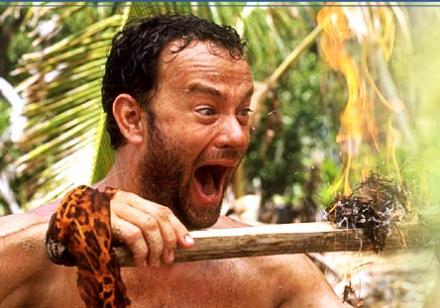
4) I often had a hard time figuring out Langdon's (see picture above) motivation for even being there. He seems to risk everything for a vague quest to solve a riddle which may-or-may-not have been addressed to him by a stranger. The character is portrayed as cautious and quiet, so why is he risking his career and freedom for this? It seems to be largely because a pretty French genius asked him to, and he misses the pretty Italian genius he fell for in the first book.

5) And finally, there is a lot of completely made-up art and religious history. Until half-way through, I was absolutely loving this book and its complex weaving of hidden historical facts and fictional adventure, because I saw it as the most exciting art class ever ever ever. When I got to looking things up (on wiki... but still...) I found that it was 90% fiction, and I was disappointed.

But the carefully-organised thriller plot, the anagrams and riddles, and the sense of tension were absolutely wonderful. Here, I guess, lies the massive success of the book. And there was an brief moment when I thought I had learned the secret of Mona Lisa's smile (and title), which felt great until I hit wiki and discovered that, no... there's no such thing as the Priory of Scion. Which is a damn shame.

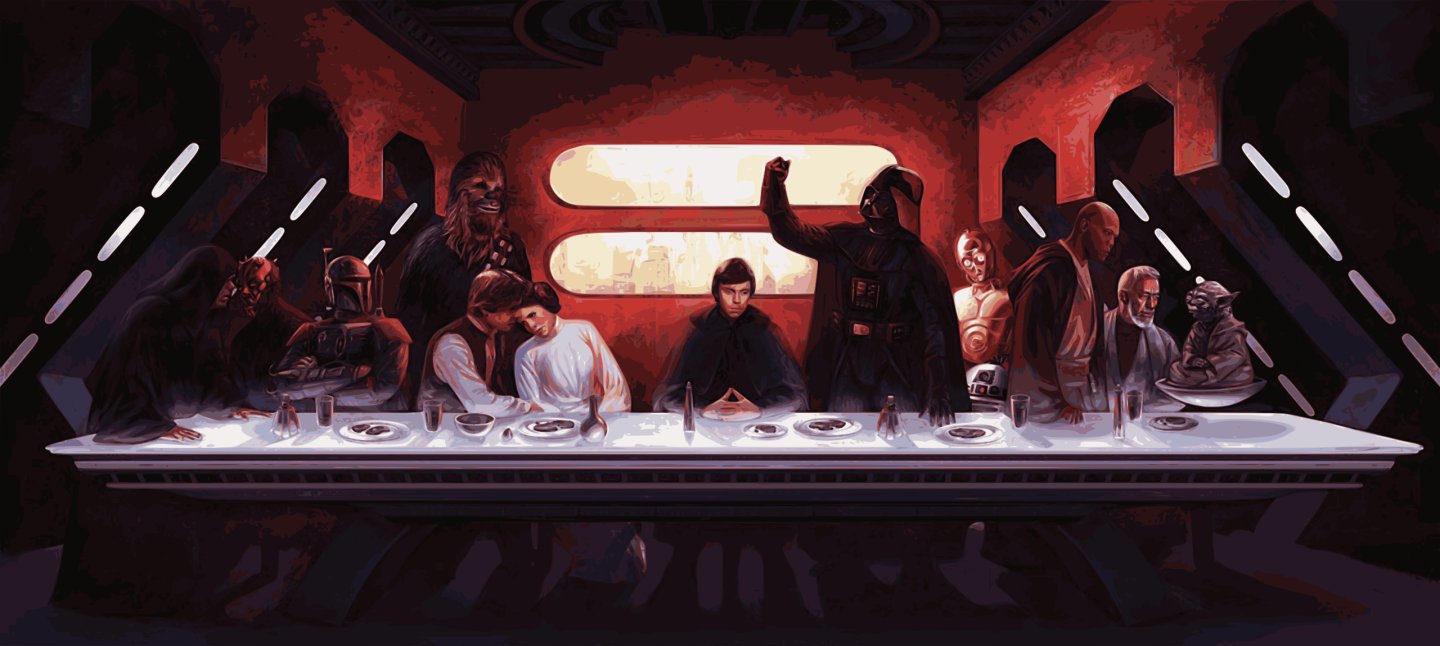
That said - I spent a long, long time examining The Last Supper after I finished reading. And I really was quite disturbed by the old, familiar image - how could I have never noticed how incredibly feminine Peter looks? I was amazed that I had never noticed.
I will be DAMNED if that's a man sitting opposite Jesus, in a colour-swapped copy of his clothes, forming a large empty space in the shape of a chalice.

Okay, it could easily be a man! I'm no art scholar. I'm barely a scholar, as I'm sure this review demonstrates.

But he looks DAMN feminine...


(Peter is the one who's about to make-out with Harrison Ford.)