I felt like writing something personal, so I thought I would talk about the huge impact Red Dwarf had on me, as a writer and in general.
If you're not familiar with the franchise, it's a British sitcom (and four comedy novels) set in space. It's a simple sitcom set-up about 'four or five people who don't get on having to live together' but which also satirises and/or pays loving tribute to all manner of space operas and science-fiction classics. The premise is simple - an amiable slob awakes after three million years of suspended animation in the middle of black, empty space. There are no aliens and no advanced civilisation. For company he has a hologram resurrection of the crewman he hated most, a creature who has evolved from cats, a senile old computer and a fussy, subservient robot.
From 1989 to 2000 they had a series of sitcom-style misadventures, and Star Trek-style adventures, all with perfect characterisation, a wonderfully dark and witty sense of humour, and fascinating storylines. I always think of it as 'Blackadder in space'. And I could spend the day writing an introduction to it!
I'm a big fan, and I'm amazed it's never come up on this blog until now. As a teenager, I watched my carefully-collected videos of this show religiously, believing every line to be flawless and the actors to be the finest comic talents on Earth. When I got older I started to see the flaws and grow tired of the well-worn tapes, but I can still remember most of the lines in the first seven series!
But one part of the franchise that remains at the highest in my estimation is the books. Beginning quite early on in the show's run, the two writers, Rob Grant and Doug Naylor (this was back in the day when British TV shows ran for six episodes a year and were written by only two people) began working on a series of Red Dwarf novels. Rather than write a spin-off or simply novelise the shows, Grant and Naylor (using the pen-name Grant Naylor) decided to begin anew, so that they were writing two seperate versions of the story at once - the TV version focused on jokes and brief adventures, and the novels' version was more dramatic and epic.
The novels Red Dwarf (AKA Infinity Welcomes Careful Drivers) and Better Than Life are genuinely brilliant sci-fi comedy. Much like Terry Pratchett or Douglas Adams, but... maybe this is me... so much better! So much deeper, funnier and more engaging.
Then came the great divide, where my heroes Grant and Naylor had a personal argument of some sort, and split for good. It was like watching my parents divorce. Grant went on to write excellent comedy novels and Naylor continued Red Dwarf, but not very well. Despite bold new ideas and characters, the show never quite recovered. It teetered away and ended on a whimper and a false 'to be continued' (well there was the recent 'Back to Earth' special, but that's another story.)
And it killed me that the show never had an ending. Now I would never know - does Lister find his way home? Do Lister and Kochanski finally fall in love? What becomes of Rimmer after his brave departure? It sounds very silly, but it took years for me to accept that I'd never know.
---
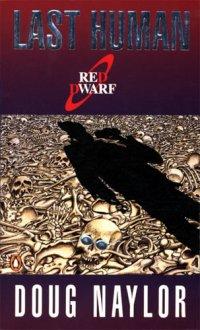
But, I distinctly remember a wonderful moment, when I was reading the last chapter of Last Human by Doug Naylor.
---
See, after the split, both authors wrote one more Red Dwarf book - each of them contradicting and disregarding the other, and each a direct sequel to Better Than Life. Now my divorced parents were asking me to choose which one I loved most. At high school I wrote a novel-length fanfiction which feebly attempted to bring the storylines into one.
Grant wrote Backwards, which took a very dark turn, but evolved to become extremely witty and with deeper characters than ever before. As well, it was a thrilling, scary adventure with brilliant science fiction in the first half (on 'Backwards Earth'). Best of all it included a massive, dramatic expansion of my favourite side-character, 'Ace Rimmer' - the dashing alter-ego of Rimmer with his legendary catchphrase, 'Smoke me a kipper, I'll be back for breakfast!'
And Naylor wrote Last Human - much more the traditional style, but with a tight, excellent space opera plot, great gags and...
... an ending.
In the final chapters of the book, Lister and Kochanski are in love, together and perfectly happy. They never made it to Earth (well they kinda did) but that's all part of the climax. All of the transformations and journeys that began in Red Dwarf and the first episode of the series come to an action-packed and fantastic conclusion, and there is nary a joke in sight. The third act of Last Human is what dreams are made of.
And though there is no Ace Rimmer, the real Rimmer brings his story arc to a close, by fathering a son and becoming the hero we'd wanted him to be since we grew to love him in episode 6.
And as he sacrifices himself to save his son and his crewmates, Rimmer sends a message in Morse code - S.M.A.K.I.B.B.F.B. Get it? It's an allusion to a character who never even appeared in this book's time-line, but that's what makes it so powerful.
I cried! I cried tears of joy that the dearest fictional character I'd ever read had finally become what I wanted him to be. I'm not saying that I prefer the Naylor book to the Grant book (don't make me choose, mum and dad!), but it left a powerful emotional effect on me.
And I re-read that book over, and over, and over again. I remember the third or fourth time I reached that ending, that perfect last chapter, and thinking, "This is what I want to do. I want to write stories with jokes and rich characters, and I want people to feel like I do now, just because of printed words. And I want to keep trying to write a book as good as this, but never make it! That'll keep me trying"
I've been through various odd phases in my life since then, but I'm never happier than when I write fiction, hear great comedy or find myself unexpectedly moved by something. Red Dwarf taught me 75% of what I know about writing, and completely shaped my sense of humour. Rimmer gave me an attitude, The Cat gave me a sense of childlike wonder, Kryten gave me too much self-deprication, and all of them have effected my strange accent. Lister gave me a laugh, some ideals, some beliefs and a hopelessly romantic soul.
Now I even like to imagine parallels between 'Buch and Knight' and Grant and Naylor!
Last year I got a tattoo of the Morse code for 'SMAKIBBFB' on my left arm. I'm not a tattoo kind of guy, but it's to remind me of my goal as I write. I can see it in the corner of my eye when I type. Like those books and some of the classic episodes, it never fails to inspire me.
The final line of Last Human never left my head. I keep wondering about featuring the line at the very beginning of one of my own stories. It would have to be a special one!
Slowly, gently, almost impercebtibly, the grass began to sway.