From Central California and Northern England, two aspiring writers natter and share a blog. We like to talk about our disparate but oh-so-similar lives, offer opinions on literature and movies... and endlessly reminisce about Bioware RPG's.


We hope you haven't had enough of our disingenuous assertions. If you have, please don't hit us.
Showing posts with label heroes die. Show all posts

Tuesday, February 8, 2011

Several Little Book Reviews

My main "New Year's Resolution" for 2011 was to do a lot more reading. I'm not currently in school at the moment, and I have no intention of spending that time in front of my XBox. (Though the thought had crossed my mind.) Thanks to the used book store here in town and the lovely couple who run the place, I'm up to my knees in quality fiction. Not only that, I'm one book away from trouncing my 2010 reading list; I really didn't read much last year.

Here's some of what I've read through so far (I'll post the rest up later):

by Sean Stewart

I've read my fair share of SW books over the last couple of years (thanks, Buch) but as of now, there are only a few left that I really think I could get some enjoyment out of. Dark Rendezvous was included on that list, along with the last few books of Timothy Zahn's Thrawn series, and the Rogue Squadron series by Michael Stackpole. The only reason I went with Dark Rendezvous was because it wasn't part of a series; at the time, I wasn't too keen on throwing myself into that kind of commitment. It's not you, it's me, and all that.

But I've gotta say, Sean Stewart's book really helped me remember why I love the Star Wars novels so much. The surprise was mostly centered on how it was a book about Yoda and Dooku, a match made in George Lucas's own personal Hell. But this book handled that Master/Padawan relationship the two characters had very, very expertly. Pound for pound, there was just as much humor as there was action and depth. I laughed, awed, and very nearly teared up on parts. Just a really great book all around. Mister Stewart really, really needs to write another SW book, because Dark Rendezvous is certainly one of the best.

The Forever War
by Joe Haldeman

This marked my first attempt at reading some of the sci-fi classics, and classic it should remain. Honestly, I can't attest to the character development or the writing style or anything like that. If this book wasn't so brilliant in concept, there'd be very little left to recommend.

Imagine a war between humans and an alien race, a war that has started to rage throughout the galaxy. On the human side of things: people are being conscripted into the military, trained on an extrasolar planet, and shoved into a war in which they have no idea how to fight their enemy. Not only that, but their FTL jumps are causing time dilation, so by the time they return home at the end of the year to resupply, decades have passed back on Earth. It's really something; the book chronicles a war that rages for nearly 2000 years, though it only seems like ten to the main character.

As it stands, this is one of those books that will just blow your mind with sheer astronomical goodness. If you're a fan of Starship Troopers or Old Man's War, give this a try.

by Michael Moorcock

One of the members of our forum (kinda) recommended the Elric books to me a while back, though he did supply some caveats to that recommendation - and I can see why. Not to say I disliked this book or anything; I can understand how this book reached "classic status" in a time when the fantasy genre was dominated by only a few authors.

Elric isn't really a hero, he's someone who deals with the realities of running a civilization that has its roots far back into history. He has some problems with the more barbaric methods of justice Melnibone has retained for many years, but that doesn't necessarily mean he can change it; civilized barbarism is the status quo in Melnibone. The moral conflicts like this were interesting, as was the world itself.

Other than that, it left me feeling pretty ambivalent about reading the sequel. The books are short enough to make me reconsider that, but with such wooden prose, uninteresting characters, and a story that sort of bordered on silly (How many times can one man get betrayed by the same person?), not sure if I'll be continuing the series, but I might give it a fair try. This was the debut novel, after all. Improvements are always possible.

by Matthew Stover

I can safely say that I'll probably read another book quite like Heroes Die until I complete its sequel. It's part sci-fi, part fantasy, and bloody as all hell. It follows an "Actor" named Caine and his exploits in an alternate dimension known as Overworld. This dimension has been exploited for many years by businessmen on our Earth as pure entertainment for the millions of people willing to pay for uncensored violence and adventure.

I've read nearly all of Stover's books, and this is definitely one of his best. If you're looking for a nice change of place in the fantasy genre, give this book a try. From what I've read, the sequels are even better. Check out my full review over HERE.

Saturday, January 22, 2011

Book Review: The Acts of Caine: Heroes Die by Matthew Woodring Stover

Gritty fantasy. It's not something I have a lot of experience with, but its existence makes several different kinds of sense. Most of the fantasy that I've read in my life follows a group of adventurers that play by the rules, be it their own or those set up by society. They have codes of honor, a strict sense of morality, an oath they must bear for the rest of their lives. The villains are usually just the same, save for the fact that they kill people for selfish gain. So, it's odd to finish a book and not quite know who the villain was, who the hero was, and who really came out on top as the victor.

It was an interesting ride, one that I should've taken a long time ago.

Heroes Die is set on dystopian Earth and Overworld, depending on how you look at it. Earth has been overtaken by a rather harsh caste system, and the main form of entertainment is the exploitation of a parallel dimension (Overworld) where elves, dwarves, dragons, fairies, and magics are very real. Earth trains up people called Actors, who are then transfered to Overworld to seek out bloody fame and fortune through Adventures, which can then be resold as "movies" of sorts. Caine is the best and most popular Actor of that generation, and he wants out of the game. But just when he thinks he's out...

His estranged wife, an Actor herself, is disappears in Overworld and the Studio has no way to bring her back to Earth. What's worse, due to the way she was transfered to Overworld, if she isn't found within the next week, she'll fall out of sync with that dimension, and will subsequently be torn through various parallel dimensions where humans have no right to exist. It's a death sentence of the worst sort. So, Caine goes back in, with the caveat that he must kill Ma'elKoth, the self-appointed Emperor of the human Empire in Overworld.

There's a lot going on in this book.

It has betrayal, gang wars, regicide, torture, incest, human sacrifice, decapitations, disembowelment, rape, mindrape, soulrape, prostitution, necrophilia... and I'm still gonna sit down here and recommend this book to you. Let me tell you why.

Most fantasy stories that you will read will play things very safe. For all intents and purposes, fantasy is a genre that always tries to be dignified. It tries to portray life as something cleaner, funner, happier. It often portrays a place you'd want to escape to. Fantasy has become Utopian fiction, in a way, and it's caused the entire genre to ruthlessly cannibalize itself. Stover pulls a one-eighty on all of that, and just kinda lets you sort it out for yourself.

On the one hand, you have an adventure that I can only compare to those of Conan. It's full of that bloody, primal fury that will have fans of good action almost clapping as they read. It's also written (for the most part) with a voice of eloquence and obvious intelligence (again, much like Conan), which allows for a really immersive trip into Overworld. But beneath all of that, there is quite a bit of social commentary: in that this is a violent book about violence. Caine's actions, good or ill, are all as a direct result of the dreaded "supply and demand" system. He's there because people demand it, and in return, he supplies the blood.

The main conflict Caine faces with this (besides overthrowing the Empire) is to show that the Studio and its executives and their consumers do not own him. He's a worker, he does a job, but he's not a slave.

If Karl Marx could write fantasy, I suspect it would turn out like Heroes Die.

The moral dilemmas are not in short supply here, and the repercussions don't die with Caine's enemies. All of Caine's actions come around to bite him in the ass at some point. This is a book that will make you think if you'd like to, but it's also a book that you can enjoy for the action, the over-the-top scenes of violence, and it'll make you wonder whether or not you should have enjoyed it as much as you did.

He's doing this for you, after all.

Heroes Die lacks the subtle touch of Stover's later works, but that was probably on purpose. Stover can be poetic when he wants to, life-changing if he's bored, and can show you a universe you didn't know existed if you open yourself to what he's really saying. There's a of that here, but it's buried deeper than I would've liked it to be. Overworld itself is the real accomplishment here, as well as the introduction of Caine, a character I am eager to pursue through his next few books.

Read this book if you want to see what fantasy's like when life gets in the way.

Monday, January 17, 2011

Caine Hits Back

It's no secret that I'm a big fan of Matthew Stover's work. Maybe I have no right to call myself a fan, since I haven't even read his original flagship franchise called the Acts of Caine, which includes three books: Heroes Die, Blade of Tyshalle, and Caine Black Knife. I'm about halfway through Heroes Die, and I've just been tearing through that thing, man. Books over 400 pages intimidate me, since I'm the slowest reader I know. 400 pages is a week's worth of effort if all goes well. But I'll be damned if I haven't knocked off those first 200 pages in just a couple of days. I was a fool to procrastinate (but we'll see what happens when it comes time to buy the sequel. Sheesh).

If you haven't heard of the series, but are an avid reader of SF & Fantasy, don't fret; very few have. The publisher of the series, Del Rey, absolutely dropped the ball on what those who have read it think is one of the most creative series in the genre. It's gotten rave reviews from Scott Lynch, John Scalzi, Joseph Mallozzi, Michael Stackpole. People like it, but Del Rey promoted it worse than a third-rate Star Wars novel. This still doesn't sit well with fans of the series, especially its author. Just take a look at the cover for Heroes Die and see Del Rey at work here.

But, recently, a talented group of artists have gotten together in the hopes of properly resurrecting Caine from the bowels of obscurity. They hope to make a comic book series out of the world of Ankhana, and they've made a ton of progress toward making this thing a reality. Matthew Stover will be writing the scripts, with a motley crew of talented, emerging artists doing all they can to get this thing into print.

If you're a fan of Stover, have an interest in getting into the series, or are just feeling overly generous: stop by the official website, check out what they're up to, and donate to the cause if you can. Every little bit helps. I've donated what I can afford (which is very little) but the amount of people donating is what's important, not necessarily a monetary amount.

So here you go: www.overworld.tv

And, again, check out his books, Star Wars or otherwise, if you haven't already. You won't be disappointed. Believe it.

Friday, April 2, 2010

(Still) remembering Red Dwarf


I felt like writing something personal, so I thought I would talk about the huge impact Red Dwarf had on me, as a writer and in general.

If you're not familiar with the franchise, it's a British sitcom (and four comedy novels) set in space. It's a simple sitcom set-up about 'four or five people who don't get on having to live together' but which also satirises and/or pays loving tribute to all manner of space operas and science-fiction classics. The premise is simple - an amiable slob awakes after three million years of suspended animation in the middle of black, empty space. There are no aliens and no advanced civilisation. For company he has a hologram resurrection of the crewman he hated most, a creature who has evolved from cats, a senile old computer and a fussy, subservient robot.

From 1989 to 2000 they had a series of sitcom-style misadventures, and Star Trek-style adventures, all with perfect characterisation, a wonderfully dark and witty sense of humour, and fascinating storylines. I always think of it as 'Blackadder in space'. And I could spend the day writing an introduction to it!

I'm a big fan, and I'm amazed it's never come up on this blog until now. As a teenager, I watched my carefully-collected videos of this show religiously, believing every line to be flawless and the actors to be the finest comic talents on Earth. When I got older I started to see the flaws and grow tired of the well-worn tapes, but I can still remember most of the lines in the first seven series!

But one part of the franchise that remains at the highest in my estimation is the books. Beginning quite early on in the show's run, the two writers, Rob Grant and Doug Naylor (this was back in the day when British TV shows ran for six episodes a year and were written by only two people) began working on a series of Red Dwarf novels. Rather than write a spin-off or simply novelise the shows, Grant and Naylor (using the pen-name Grant Naylor) decided to begin anew, so that they were writing two seperate versions of the story at once - the TV version focused on jokes and brief adventures, and the novels' version was more dramatic and epic.

The novels Red Dwarf (AKA Infinity Welcomes Careful Drivers) and Better Than Life are genuinely brilliant sci-fi comedy. Much like Terry Pratchett or Douglas Adams, but... maybe this is me... so much better! So much deeper, funnier and more engaging.

Then came the great divide, where my heroes Grant and Naylor had a personal argument of some sort, and split for good. It was like watching my parents divorce. Grant went on to write excellent comedy novels and Naylor continued Red Dwarf, but not very well. Despite bold new ideas and characters, the show never quite recovered. It teetered away and ended on a whimper and a false 'to be continued' (well there was the recent 'Back to Earth' special, but that's another story.)

And it killed me that the show never had an ending. Now I would never know - does Lister find his way home? Do Lister and Kochanski finally fall in love? What becomes of Rimmer after his brave departure? It sounds very silly, but it took years for me to accept that I'd never know.

---

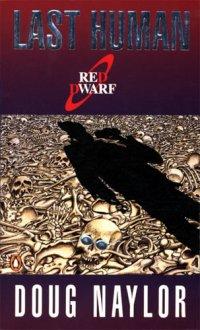
But, I distinctly remember a wonderful moment, when I was reading the last chapter of Last Human by Doug Naylor.

---

See, after the split, both authors wrote one more Red Dwarf book - each of them contradicting and disregarding the other, and each a direct sequel to Better Than Life. Now my divorced parents were asking me to choose which one I loved most. At high school I wrote a novel-length fanfiction which feebly attempted to bring the storylines into one.

Grant wrote Backwards, which took a very dark turn, but evolved to become extremely witty and with deeper characters than ever before. As well, it was a thrilling, scary adventure with brilliant science fiction in the first half (on 'Backwards Earth'). Best of all it included a massive, dramatic expansion of my favourite side-character, 'Ace Rimmer' - the dashing alter-ego of Rimmer with his legendary catchphrase, 'Smoke me a kipper, I'll be back for breakfast!'

And Naylor wrote Last Human - much more the traditional style, but with a tight, excellent space opera plot, great gags and...

... an ending.

In the final chapters of the book, Lister and Kochanski are in love, together and perfectly happy. They never made it to Earth (well they kinda did) but that's all part of the climax. All of the transformations and journeys that began in Red Dwarf and the first episode of the series come to an action-packed and fantastic conclusion, and there is nary a joke in sight. The third act of Last Human is what dreams are made of.
And though there is no Ace Rimmer, the real Rimmer brings his story arc to a close, by fathering a son and becoming the hero we'd wanted him to be since we grew to love him in episode 6.
And as he sacrifices himself to save his son and his crewmates, Rimmer sends a message in Morse code - S.M.A.K.I.B.B.F.B. Get it? It's an allusion to a character who never even appeared in this book's time-line, but that's what makes it so powerful.

I cried! I cried tears of joy that the dearest fictional character I'd ever read had finally become what I wanted him to be. I'm not saying that I prefer the Naylor book to the Grant book (don't make me choose, mum and dad!), but it left a powerful emotional effect on me.

And I re-read that book over, and over, and over again. I remember the third or fourth time I reached that ending, that perfect last chapter, and thinking, "This is what I want to do. I want to write stories with jokes and rich characters, and I want people to feel like I do now, just because of printed words. And I want to keep trying to write a book as good as this, but never make it! That'll keep me trying"

I've been through various odd phases in my life since then, but I'm never happier than when I write fiction, hear great comedy or find myself unexpectedly moved by something. Red Dwarf taught me 75% of what I know about writing, and completely shaped my sense of humour. Rimmer gave me an attitude, The Cat gave me a sense of childlike wonder, Kryten gave me too much self-deprication, and all of them have effected my strange accent. Lister gave me a laugh, some ideals, some beliefs and a hopelessly romantic soul.

Now I even like to imagine parallels between 'Buch and Knight' and Grant and Naylor!
Last year I got a tattoo of the Morse code for 'SMAKIBBFB' on my left arm. I'm not a tattoo kind of guy, but it's to remind me of my goal as I write. I can see it in the corner of my eye when I type. Like those books and some of the classic episodes, it never fails to inspire me.

The final line of Last Human never left my head. I keep wondering about featuring the line at the very beginning of one of my own stories. It would have to be a special one!

Slowly, gently, almost impercebtibly, the grass began to sway.

Saturday, July 25, 2009

Heroes Die

So, I just got through talking with my friend, whom I had lent all three of my Matthew Stover books to. I had my hands full with my Star Wars books and The Lies of Locke Lamora, so I sent them all his way.

Basically, he returned Shatterpoint and Revenge of the Sith and said: while they were well-written, they just weren't his thing--Star Wars hasn't been his thing for a while, apparently (although I did get him all hyped up for The Old Republic mmo, so that's a point for me).

But I got in the car with him tonight for a quick cruise and a smoke, and he told me, before anything else, Heroes Die is now on his top ten list.

This is of some significance, because my friend is very particular about the fantasy stories he likes, and he's practically read them all to find those handful. From Robert Jordan to George R. R. Martin, from Brandon Sanderson to R.A. Salvatore, this guy has read thousands of books.

And Heroes Die made it into his top ten, even though he still has a hundred pages left in it.

Not that it surprised me: Matthew "Fucking" Stover is a brilliant author. I brought up this list that mentioned Heroes Die in the same breath as The Song of Ice and Fire by GRRM. My friend whirls on me, smoke fuming from his nose and hate spewing from his mouth in regards to Martin's work, and lays out a long ass case proving how much better Stover's work was in his opinion (though, he would claim that anyone who didn't share his opinion was someone less-than-human).

Jubilations! Can't wait for him to finish it now. Although, I am almost hesitant to get excited. If I like Heroes Die, I know I'll have to buy the second book, Blade of Tyshalle; which, if you look at the Amazon page, costs about thirty wing-wangs used (and $100 new!). So that might be difficult to do. It might be cheaper to step up my harassment game and get Stover to send me one.

Makes me wish his publisher would re-release those damn books. He's mentioned an omnibus of some kind before. Here's hoping that happens. xD