From Central California and Northern England, two aspiring writers natter and share a blog. We like to talk about our disparate but oh-so-similar lives, offer opinions on literature and movies... and endlessly reminisce about Bioware RPG's.


We hope you haven't had enough of our disingenuous assertions. If you have, please don't hit us.
Showing posts with label review. Show all posts

Tuesday, September 20, 2011

DLC Review/Retrospective - Fallout: New Vegas - "Lonesome Road"

"If they matter... if history matters... we'll see at the end of the road."

The opening moments of Fallout: New Vegas see you shot in the head and left buried in a shallow grave somewhere in the Mojave. Somehow still clinging to life, you're rescued and brought to the town of Goodsprings, where Doc Mitchell cares for you until you've made a full recovery. This is not the beginning of your story, the Courier's story, nor is it the end - but it was meant to be.

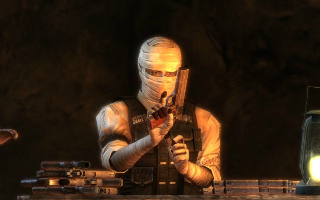
Enter Ulysses: the original Courier Six. The man who was supposed to deliver the Platinum Chip in the first place, but backed out of the job when he saw that you were next in line. Aware of what he'd be carrying, and knowing full well that the job was very likely a suicide mission, he stepped aside in the hopes that you would be killed before you even made delivery. Obviously, this didn't happen, much to Ulysses' disappointment.

But who is this other courier? Why does he want you dead?

Throughout Fallout: NV and it's subsequent add-ons, this story arc quietly builds in the background. A throw-away comment here, an oddly-named item there, until eventually it comes to a head. And it all begins with you sitting in a cave somewhere in the Big Empty, hearing Ulysses' voice on a holotape, the contempt he has for you and everything you've supposedly done. And in the closing seconds, he makes a solemn promise:

"At the Divide, he and I... there, we'll have an ending to things."

And he would be right.

Lonesome Road has you tracking down Ulysses through the Divide: a massive fissure that's formed in the middle of a once-thriving city of the Old World. Here, the wind is strong enough to tear the skin from your body, irradiated soldiers from both sides of a dead conflict wander in a haze of insanity, and mutated creatures lie in wait just below the surface. It's very unlikely that you'll find your happy place here. This is a depressing, emotional, and heart-breaking road you must travel, but I couldn't think of a better way for this game to come to an end.

This is your story. Your road. You're here because you want to be, and you can leave at anytime. But if you keep walking... you're gonna see some things.


The Divide ain't what it used to be.

The first thing you're going to notice about the Divide is, well, that it's pretty damn big. You begin on a cliff overlooking the whole of it, and it's just an amazing sight to see. I just sat there staring for a bit, and eventually said to myself, "Shit, I gotta walk through that." The Divide ain't pretty like Zion; it's a very intimidating piece of real estate. This is made even more interesting by how it was designed. Unlike the other three DLC hubs - The Sierra Madre, Zion, and The Big Empty - The Divide is actually one long road, winding through ruined cities, collapsed tunnels, across highways, and down into the giant fissure. You're still free to come and go and explore as you please (and there are still a ton of places to poke around), but since you're always moving forward through the landscape, you're never quite sure where you're going to end up next.

In this sense, Lonesome Road definitely has the most variety out of all the add-ons. Each of the locations in the Divide are unique from each other in some way. They're very competently-designed, and clearly show that Obsidian intended to go out with a bang, throwing as many eggs into that proverbial basket as they could. Buildings collapse into the fissure, earthquakes will knock things off of shelves, and debris constantly blocks your way. But wait! You can remove that debris by seeking out discarded warheads and setting them off with your trusty detonator. Time the explosions right, and you can take out some advancing enemies, too.

There are new armor sets, new items, new achievements, and new weapons, such as the "Red Pulse," which is pretty much an automatic rocket launcher. (It's as awesome as it sounds.) The only real downside is that since the Divide is an undesirable place to be, there isn't a surplus of NPCs to talk to. In fact, besides Ulysses, you'll only have your companion to talk to, but I'm not sure if I should spoil who that companion is. Not a big deal, but it was fun to discover who you'd be traveling with (and also figure out said companion's backstory.)

So what can you expect from the ending? Well, I can say that it was definitely a satisfying one, and will have vastly different outcomes depending on your decisions, a few of which were pretty tough for me to think through - and one of which can draw direct comparisons in terms of severity to the infamous Megaton decision from Fallout 3. So severe, in fact, that the Mojave Wasteland itself will be affected in some way: a first for FO DLCs.

And what of Ulysses? Again, I can't say much about him or his vendetta against the Courier. But rest assured, he has a very good reason to hate you, and it's not a reason that will sound completely out of the realm of possibility either. (Actually, I found myself thinking that I probably would've done the same thing in the Courier's shoes.) As Ulysses once said, "Couriers sometimes don't know the messages they bring."

Lonesome Road marks an end for the story of the Courier, a story that I've been following with much enthusiasm for the better part of a year. In that year, I've seen Obsidian create what I believe to be a masterpiece in the RPG genre: a game that not only aspired to have a great story, but great characters, locations, sidequests, world-building, and a level of immersion second to none. And then they decided to take things a step further, by creating a set of add-ons that could be collectively seen as a sequel in its own right.

Bethesda may have continued and updated the Fallout property, but Obsidian Entertainment refined it to the point of near-perfection, creating a product that trumps its predecessor in nearly every way. The franchise simply could not be in better hands, even if Bethesda decides to make the eventual sequel themselves. Obsidian know the lore, inside and out, they know what works, what doesn't, and how to tell stories within the universe that pack the hardest punch. I don't think I've played a game where a developer has had such a tight grip on such detailed lore and knew exactly how to wield it.

Fallout: New Vegas, along with all of its DLC - Dead Money, Honest Hearts, Old World Blues, and Lonesome Road - has been one of the best gaming experiences I've ever had. It will most definitely go down as one of the best games I've ever played, up there with Knights of the Old Republic and Dragon Age: Origins.

Obsidian (and Chris Avellone, especially) should be proud of themselves, and it's my hope that they're allowed another crack at the property. My dream would involve Obsidian, Fallout, and the Skyrim engine, but only time will tell.

This is an end for the Courier, but I hope it's not the end. Either way, all roads lead home, and for now, the Courier's right where he needs to be.

Wednesday, August 31, 2011

Game Review - Deus Ex: Human Revolution

He never asked to be born a badass. It just happened.

One of your first missions in Deus Ex: Human Revolution is to thwart a hostage situation at one of your boss's subsidiary companies. Not so difficult; just get in there, shoot the bad guys, rescue the good guys and go home right? Well, yeah, it can be that simple, or it can be as complicated as you want it to be.

Not feeling up to busting down the front door and gunning down everyone between you and the hostages? That's fine because there's an entrance on the rooftop that'll make it easy for you to get the drop on them. But maybe you're not feeling up to using your gun either? That's fine, too, because if you're real quiet, you can sneak around and crawl through some air vents to get to where the hostages are being held. Oh, but there are a few guys blocking your way and you're not so sure you can sneak around them. Well, there's always your tranquilizer rifle! Shoot one of them in the face, watch his buddies run to his aid, and then sneak around to the elevator.

Wham, bam, you're at the hostages... But maybe you don't feel like rescuing these hostages. Maybe that gas bomb they're stuck with is a little too close to hitting zero, and your hacking skills aren't as keen as you'd like them to be. Maybe you don't want to die, not on your first goddamn mission. So you run, you get your ass out of there and hear the hostages' screams go quiet. Maybe you feel guilty, or maybe you don't, but either way there will be no Mission Failed sign for you. But later on down the line, there will be some consequences that you'll inevitably have to deal with, or perhaps some people won't look at you the same anymore.

This is the case for most of the many, many missions in Deus Ex: HR, where sometimes ignoring someone will have consequences eventually. And this hostage situation was just the tutorial.

But anyway: Welcome to Detroit!

You'll be playing as Adam Jensen (a sort of near-future Clint Eastwood), the chief of security for a multi-billion dollar corporation that specializes in artificial limbs and implants. (Collectively called "augments".) In the opening moments of the game, the corporation, Sarif Industries, is attacked by heavily-augmented terrorists, leaving most of the science staff, along with Jensen's girlfriend, dead by way of unsubtle means. While attempting to save the staff, Jensen is mangled and left for dead, but his employer sees fit to save his life by turning him into something of a cross between The Six Million Dollar Man and Robocop - except with kickass sunglasses.

Jensen gets back to work - like a boss - with his heavily-augmented body and continues to solve Sarif Industries' problems. Along the way, murmurs of a corporate conspiracy start arising, so Jensen must begin to balance his own personal interests (player's choice) and the demands of his boss if he ever wants to figure out the exact circumstances of his girlfriend's death. And it will be one crazy ride to get there.

It's very hard for me to give you an exact impression of what you'll be facing in Deus Ex: Human Revolution because of just how much you won't see on your first playthrough. I was going all out, exploring everything that I could, every corner of Detroit and Shanghai. It surprised me to no end when I found out, by way of the achievements that didn't ding for me, how much of the game I had missed! To that end, DE:HR is probably more comparable to Obsidian Entertainment's past ventures: Fallout: New Vegas and Alpha Protocol, on account of the very dynamic storyline. Entire sections of the game will be lost to you depending on your choices. This is a game that all but demands multiple playthroughs.

Not to mention that the story itself is very well-written. There are twists and turns, with all of the quests being very derivative of its hard science fiction theme. It makes it a very immersive experience when your missions involve collecting a debt from someone who got themselves some black market augments, or breaking up an illegal neuropozine smuggling ring. There are also a lot of very good points of debate that are brought up. Would human augmentation be a perversion of our very humanity? Or a harmless way for us to rise above our natural hindrances? I dunno.

Now on to the gameplay. As I said before, there are multiple ways you can approach this game. You can be all combat, all stealth, or someplace snugly in between. You could even go all melee if you wanted to, and bring down everyone with lethal or non-lethal takedowns. As a game that allows you the option to play how you like, it's pretty good at everything. No, the stealth sections aren't as good as those from the Splinter Cell series, you won't be shooting out lights or keeping to the shadows, and the FPS combat isn't as refined as Battlefield: Bad Company 2. But its still fun. Fallout 3 and New Vegas didn't have to be those games either to be absolutely immersive and entertaining.

But the RPG elements, the augmentation and conversation systems, are absolutely refined. The augments allow you to play your way, and play them awesomely. If you like sneaking around enemies, place points (called "praxis kits" in the game) into making your footsteps silent or refining your hacking abilities, which allows you to open locked doors, shut down surveillance cameras, and even turn robots and turrets against your enemies. If you're more of a warmonger, you can increase your dermal armor, install the "Icarus Landing System" so that even jumping off a ledge will get someone killed, or make your augmented weapon, the "Typhoon", even more devastating.

And BioWare take note, DE:HR employs the use of a conversation system that I found wholly superior to those of the Mass Effect series and Dragon Age 2. Though there weren't as many options as I would've liked, nor did they pop up as frequently as I would've liked, knowing the intent of what you were going to have Jensen say, as well as knowing almost exactly what was going to be said, was very welcomed. This means that attempting to sigh doesn't turn into a death threat, as in Exhibit A.

This is a great game all around. The story, gameplay, visuals, characters, locations, RPG elements: all stellar. It's not a perfect game, though. There are a few things that keep it from absolute greatness in my mind.

The first are some technical hiccups. Let's keep in mind that DE:HR is the premier title for Eidos Montreal. The pressure could not have been any higher, as both a sequel to a beloved franchise and their first game ever. But I'm sure there were limitations, as the animations and lip-synching aren't really up to snuff for the most part. You'll see most of the women performing the same body movements, and when people speak, their lips are only just keeping up with what they're supposed to be saying. It's pretty noticeable at first, but eventually, depending on your interest in the story, you'll probably end up forgetting all about it.

The second, bigger, flaw that I personally took umbrage at was the boss fights. Yes, in a game that emphasizes player agency and freedom of choice, you are downright forced to fight your way through a series of bosses. You can't talk your way out of them or circumvent them in any way. Regardless of your spec - stealth, hacking, etc. - it's gonna be combat time. People with points in shielding and the typhoon weapon will have no problem, while everyone else will likely struggle a bit. In any case, they're an unwelcome element, especially since they're the least characterized NPCs in the game, which only adds insult to injury. The cliche monster is almost nowhere to be found in the rest of the game, but rears its ugly head here with a vengeance.

That being said, Deus Ex: Human Revolution still manages to rise above its flaws. I would personally call it a masterpiece of the genre: an RPG that actually gives meaning to the words (acronym?), though it's not as big of a sandbox as Fallout 3 or New Vegas, and it's not as pretty as Mass Effect, it sits in the vacuum left over by both series and should satisfy fans of both. Unlike Mass Effect, your choices really do matter, and unlike Fallout the story is much more prevalent. It's pretty much a happy medium between the two.

I hope it doesn't take another four years of development for Eidos Montreal to get a sequel out the door, but this game has more than enough content to keep us playing for some time. Not to mention that their next project, already in development, is Thief 4. Weeeee!

Wednesday, July 20, 2011

DLC Review - Fallout: New Vegas - "Old World Blues"

Yes, you've lost your brain. Don't think about the medical inconsistencies; you lack the equipment for it, anyway.

Let's face it: the Courier's had a rough time of things. Getting shot in the head wasn't enough, neither was getting caught in the middle of a war between three very powerful factions, nor was getting gassed and taken prisoner and forced to crack open a vault in a mythical casino whilst wearing a bomb collar. As the saying goes: things are gonna get worse before they get better.

And in the case of our respective Couriers, things are looking to get much worse.

"Old World Blues" marks a significant jump in quality for Obsidian. Whereas "Dead Money" had a brilliant story and "Honest Hearts" had a place worth exploring, this new add-on tries to do both - and do them both better. Influenced by science fiction of the 50s and the classic Fallout titles, the opening for "Old World Blues" involves a crashed satellite, a ruined drive-in, and a science fiction picture show. Very fitting.

Eventually, you'll end up at the Big Mountain Research Facility, commonly referred to as "The Big Empty" amongst Mojave residents. You have no idea how you got there, why you're there, and, oh yeah, your brain's been removed. This is all explained to you buy a group of five disembodied scientists collectively known as the Think Tank. It seems in their blind rush to progress Science, your brain was removed and you, unlike many others, did not die a horrible death during the removal. This makes you special... for some reason. The Think Tank don't come by many answers easily, if at all.

Because you're special and because you did not die, the Think Tank decides to send you on a mission to recover various technologies around the Big MT facility. They've since lost your brain, apparently, and the only way to get it back into charge headlong into the facility of the mad scientist, Doctor Mobius. These technologies will both allow you to fight his army of atomic robo-scorpions and give you an entrance into his facility so that you might be reunited with your brain.

If it all sounds a little convoluted, that's because it is. The Think Tank aren't all that they appear to be; in fact, they're much, much less than that. They're all manner of crazy and confused about everything, but they do have a flair for dramatics, which you will get a taste of during your initial introduction. To be blunt, these are some of the most entertaining and hilarious video game characters I've come across in quite some time. They had me in stitches pretty much every time they spoke, and it never got tiring. These are characters who fully embody the corny (and awesome) science fiction of the 50s. Everything must be atomic, everything is forbidden, and Science will save us all from the darkest of futures.

Communism, of course.

In any case: thus begins your journey to recover your brain, which will have your crisscrossing Big MT and all of its fantastic locations. The Big Empty isn't as claustrophobic as the Sierra Madre, nor is it as barren as Zion National Park. The place is simply a joy to explore aimlessly, and there's a lot of it. Every facility houses information about Big MT's questionable past and further insight into the minds and "work ethic" of the Think Tank. The place is thick with history and expands the lore of the Fallout universe greatly. I was genuinely compelled to check every nook of every facility I came across. You never know what you're going to find.

One room that I almost passed over housed a robot/human splicing machine. It's as crazy as it sounds.

Over the course of your journey, you might come into possession of various holotapes that contain, get this, personalities for your household appliances. One of the perks of doing missions for the Think Tank is having your own base of operations called "the Sink", which contains a bed, plenty of storage, soda machines, your own personal auto-doc and market. But plugging these personalities into the appliances around the Sink will net you some hilarious results. A gardening machine that sounds like Issac Hayes and constantly demands your "seed," a toaster bent on destroying the world, and an obsessive-compulsive securitron named Muggy who's programmed to clean coffee mugs - to name a few.

So, "Old World Blues" has character in spades, a great sense of humor, and a great zone to support it all. The story? It's pretty good, too! Like "Dead Money," a lot of the story is in the details, and it rewards those who take in the sights. But overall, your goal is to stop a mad scientist and steal your brain back. That should be enough for most people. (It was for me.) But the story does try to make you care about what's really going on. As I said, nothing is as it seems, which results in a few decisions that you'll have to make in the end that, in my case, had me sitting there thinking for a while.

And as for the "War of the Couriers" story arc, it's definitely continued here. You'll get a better understanding of just who this Ulysses is, what he wants, and why he carries the flag of the Old World on his back. You'll have to do a little digging though. But if you do, you'll uncover answers to some of the many mysteries surrounding the Sierra Madre, hear the voice of an old friend (who has since lost her voice), and get an idea of how things might come to an end in the next/last add-on.

"Dead Money" was brilliant, but had problems in the combat department. "Honest Hearts" was enjoyable, but its brevity and lack of a compelling storyline made it touch and go for a while. But "Old World Blues"? That's a no-brainer. If you have Fallout: New Vegas, this is a must-buy. No question about it. There's good humor, plenty of role-playing opportunities, a fascinating world to explore, rich lore, and the entire thing is one big celebration of early science fiction. The thing's not short either. I did a little exploring, but I still haven't finished all of the sidequests, and it took me a little over ten hours to finish.

Obsidian really pulled out all of the stops for this expansion, fully displaying that they are in possession of some of the most creative individuals working the RPG scene these days. With "Old World Blues," they've raised the bar very high, both in terms of what a DLC add-on should be and for the last add-on due to be released a some point in the next few months. If "Lonesome Road" doesn't disappoint, Fallout: New Vegas in addition to these add-ons may end up being one of the best video game experiences I've ever had. (Yes! Potential hyperbole! Deal with it, World!)

I still have some exploring to do, and I'm very grateful this ride isn't over yet. For the Courier, there is still one more road left to travel.

Thursday, July 7, 2011

DLC Review(s): Alan Wake - "The Signal" and "The Writer"

Avert your eyes. Minor spoilers ahead.

The conclusion of Alan Wake was a bittersweet one, but I honestly couldn't imagine a better way to bring the story to a close. Without giving too much away, it doesn't seem like Mr. Wake will be going anywhere for a while. Trapped in a place he'd rather not be, his only hope of getting back to the real world is to write himself back into it. Unfortunately, he's developed a rather violent form of writer's block, where his anxiety and overactive imagination have collided in such a way that his rational side has been pushed away into a nightmare.

Both Alan Wake add-ons, "The Signal" and "The Writer," focus on Alan's rational self as he tries to make his way back to the cabin and out of harm's way. To do this, he has to survive a nightmare of his creation. These are ultimately two stories of a writer having his own imagination turned against him.

The Signal:

This add-on begins in much of the same way the main game did, with Alan Wake stumbling into the Oh Deer Diner in Bright Falls, though things are certainly different this time around. The darkness is everywhere, perverting Wake's memories to the point where they're blending into each other. A door to the city streets might lead you somewhere else entirely, and things only get worse as Wake's insane self dives further into madness.

In short: someone done crossed the streams.

Though I loved that this add-on continued the story in an interesting way, it didn't advance beyond the initial concept. For the most part, you'll be fighting the Taken. A lot of them. An unusual amount, actually. Whereas the game itself had the battles spaced out quite a bit, there's nothing like that going on here. After you figure out just what the heck's going on with Wake, there's little else to be impressed by outside of a few interesting set pieces.

But you know what? It was still enjoyable. And if you buy Alan Wake new, you get it for free. So, while I can't complain too much, I will say that the few things that I didn't like about the main game seem to compose the core of this add-on. There are way too many fights, another shameless instance of product placement, and the story doesn't advance much after the first fifteen minutes or so.

But it's still pretty dang spooky, and, again: free.

The Writer:

"The Writer," on the other hand, was a perfect example of what I'd expect out of an Alan Wake story. It expands upon some of the questions that the main game left unanswered, has some very good character moments, and has probably one of the craziest sequences I've ever seen in a video game. It's similar to the hallucination from Fallout 3 - Point Lookout, or Nightmare Hollow from Fable 2... but waaaay creepier.

Basically, "The Writer" feels like a proper descent into madness. I honestly couldn't tell what was going to happen next, and when the crazy stuff happened, I couldn't believe I had just played such a thing in a video game. I was awed, I'll say that much. Even the combat sections were creative as all hell and, most importantly, fun.

The ending is a nice teaser for what could happen in future Alan Wake installments, and I honestly can't wait. Sounds like we have something coming soon, but the announcement was definitely vague. In any case, I'll take what I can get!

Sunday, May 29, 2011

DLC Review - Fallout: New Vegas - "Honest Hearts"

"Honest hearts produce honest actions."

To its credit, the second add-on for Fallout: New Vegas has a lot to say - it just doesn't give itself enough time to say it. Whereas Dead Money had much to throw at you about greed and deception and trust, Honest Hearts kinda just throws you the Spark Notes. That's not really a bad thing at all, considering what you end up getting, but it does mean you might be able to brush off the story a lot sooner than you'd hoped.

Even then, it still ranks very, very high on the list of Fallout DLC, possibly even above Point Lookout. Maybe.

It begins with a radio signal, as they always do, and an invitation to join the Happy Trails Caravan Company on a trek through Utah, and a place called Zion. Apparently, the company has fallen on hard times, and this will be their last run if they're unable to unload their goods. They're not taking any chances, so you're hired to go along for the ride as security.

But you'll quickly find that your efforts were all for naught and things go terribly, terribly... terribly wrong for the caravan, just before you're thrown into an unstable conflict between three warring tribes in Zion. Yeah, didn't see that coming either.

The rest of the story will have you picking sides and deciding the fates of the native tribes, all the while being prodded by the mysterious Burned Man, Joshua Graham. And while all that's going on, you'll become privy to even more details on how the DLC storyline is going to eventually end up playing out. This, I thought, was the most interesting part of the add-on.

Unlike those of Fallout 3, all of the add-ons for New Vegas are connected in some way, quietly building up a scenario in which you will eventually cross paths with another courier. Who this courier is and why he means trouble is still (kind of) a mystery, but I think that's an amazing thing to try and pull off with downloadable content: to essentially give you a whole other game with its own underlying narrative.

But that's neither here nor there. The truth of the matter is that you're mostly paying for access to Zion National Park, since the story, and all of the characters (excluding the Burning Man) are largely uninteresting. People who are aware of the Mormon tradition of sending missionaries to "uncivilized" countries will get where Honest Hearts is coming from, and it really doesn't try to do much more than that.

Unlike Dead Money, though, it's a much more cohesive experience. You might die, but nowhere near as much without that collar around your neck. You might get strapped for ammo, but you won't be scrounging for it in every box and dresser you find. So, long and short, it's a more relaxed add-on. The lack of compelling characters was a turn off, as was the laid back story, but it was, overall, a satisfying expansion. Zion will always be waiting for you when your quests come to an end, though what state its in when you leave will ultimately be up to you. For that reason alone, it's definitely worth the purchase.

Tuesday, March 29, 2011

DLC Review - Mass Effect 2: Arrival

"The number of people Shepard has just disappointed with this DLC."

Let's say you've made a video game series that has just taken the industry by storm: an in-depth, absolutely gorgeous, and intriguing space opera that has sold millions of copies around the world. While fans hold their breath for the sequel, you decide you want to send this last game out with a bang before the inevitable conclusion to the series: an epilogue, if you will. Wouldn't it behoove you to make a bookend that will just...gosh...blow the player away, so that they have no choice to wait for the next chapter on pins and needles?

Wouldn't it?

BioWare?

...Wouldn't it?

To those of you who have not played this last add-on for Mass Effect 2 - dubiously-named "Arrival," since nothing technically arrives just yet - I'll keep spoilers to a minimum. But, honestly, there's not much to spoil; your best guess is probably better than what this add-on has to offer.

The add-on begins as all of them inevitably do: "You have a new message waiting for you at your private terminal." This time, Shepard takes it in his office, and it turns out to be Admiral Hackett, who contacts you through your...model ship display. I kid you not. Basically, the good admiral needs you to rescue one of his contacts, who has hard evidence of a Reaper invasion and would like her rescued because of this.

But let's back this up real quick and analyse this. First: Why would a model ship display double as a monitor? Shepard has like 100 real monitors at his disposal. Secondly: You have to realize that Hackett is asking you, Shepard, to rescue this scientist because she supposedly has the Reaper's smoking gun. Because, certainly, Shepard has never had any dealings with the Reapers in the past, and has absolutely no evidence to back him up - well, depending. But anyway, Hackett's basically looking you in the eye and saying those two games' worth of action weren't enough to convince anyone (still!), so you'll have to do a bit more.

"Okay," says I. And suddenly everyone forgets that the Alliance Navy spent the entirety of ME2 snubbing Shepard on account of his ties to Cerberus.

But here's the real kicker. Admiral Hackett wants Shepard to go in alone. Why? Because he feels that any more than one person going in and shooting up the place will result in the scientist being killed by her Batarian captors. "Go in alone, or don't go in at all," he tells me. So, perhaps fearing Hackett's omnipotence, I agree. Even though, if it were up to me, I definitely would have brought Garrus along. Just saying.

This kicks off what is essentially an hour's worth of running and gunning, with little substance beyond what occurs in the last ten minutes (and even that wasn't all that impressive). There are no real decisions to make other than to agree eagerly or indifferently. There is one outstanding moral dilemma, but the game will not let you make it since Shepard automatically agrees with the entire thing. So, for pretty much the entire hour, you're on moral autopilot.

And let's not forget the twist, which I found so laughably bad and cliched that I got myself killed from the shock of it.

After being so disappointed by Dragon Age 2, I cannot believe I've been stung twice by BioWare in a single month. This was not the add-on or the epilogue that "Arrival" should have been. This wasn't worth all the promotion, hype, and the little advertisements that were sent along inside copies of DA2. What this $8 add-on amounts to is an hour of shooting guards and a revelation of what might happen in Mass Effect 3, though I doubt it'll be all that impactful, since you're still going to have players who won't get this add-on. The story can't change dramatically for some.

If you've bought all of the DLC and just have to buy this, then I won't stop you, but I can tell you that I was very, very disappointed by "Arrival". Heartbroken, might be a better word. It's a huge shift in quality that I wasn't expecting after the very good "Lair of the Shadow Broker." I find myself saying the same thing after Dragon Age 2. All they had to do was match the quality of the last game (or DLC) and they would've been golden. Instead, they slapped together something for a quick dollar, selling people on their reputation instead of the quality I know they're capable of.

1 out of 5 Stars

Tuesday, March 22, 2011

Game Review: Dragon Age 2 - Part 2


Part One can be found HERE. Or two posts down.

The Gameplay: "Lightspeed too slow?!"

Thinking back to games like Knights of the Old Republic and Dragon Age: Origins, I don't ever remember putting the controller down and saying to myself, "You know, this game would be a metric shit-ton better if every time you pressed a button, something awesome happened." In fact, out of all the criticism I saw leveled at DA:O, and in between the dozens of "Game of the Year" awards KotOR received, I don't recall there being an overwhelming outcry for frantic, can-hardly-keep-track-of-it action.

Does that mean I don't want it now that BioWare have given it to me? Not necessarily. I don't want to be the one to complain about an improvement, but that's what I'm here for. There was a long list of things that I wanted to see improved in a sequel to DA:O. Better environments, better armor, more weapons, a better inventory system, a continuation of the veritable carpet of loose threads that the story left open for a sequel. Not to mention how a third of the game is spent in loading screens. It's like BioWare saw the list of things that I wanted to see improved and picked the one at the bottom of the list.

But let me take a step back and take a look at the combat from a positive perspective. Accounting for the fact that the auto-attack option was (and still is) intended to be integrated into DA2, I'll say that I really found myself enjoying the combat for the most part. If I had to describe this production in one word, it would be "zazz," because BioWare really wanted to draw in a gaming demographic who like to do cool things and look cool while doing it (i.e. God of War, Dante's Inferno, CoD). The combat in DA2 has a lot of zazz.

"Jumped by penniless thieves? CHOP 'EM IN HALF!"

As a rogue, smashing on the attack button (you have to smash it) will send you flying across the battlefield, plunging your blades into your enemy's chest, and drawing a fountain of blood from him in the process. If you've played the demo, you've seen this in action. It looks bloody magnificent, and things only get better when you start growing your talent tree. When BioWare said, "Fight like a Spartan!" they didn't mean in any historically accurate sense, because, you know, they really didn't fight like Hawke tends to. No, BioWare meant, "Fight like those kickass Spartans from fucking 300!" and this is closer to the truth, though I don't remember seeing a phalanx in there anywhere...

So, the combat certainly looks great and feels great. I remember groaning aloud when I tried it out for the first time, but it grew on me. Not to say I prefer it over the "old way" though. With so much happening, with the difficulty curve on the easy side for the most part, it's easy to find yourself disregarding your talents in favor of just smashing the attack button. As a mage, I certainly find myself doing this constantly. The thing about the Old Way: it was manageable. It required you to get tactical, and that's what I enjoyed about it.

This New Way is enjoyable. I personally loved seeing Hawke disappear into the shadows and reappearing behind an enemy for a backstab (it's pretty much "shadowstep" from WoW). But you lose a lot of the depth that the Old Way had. Hawke kicks ass from Day One, with all the zazz that can be pumped into a character without making him seem like the Maker Himself. The Warden had to earn his skills, moving from boring, old, and basic auto-attack to skill after devastating skill, and had to deal with the agonizing feeling of being rewarded for his efforts with talents that only rival those of Hawke's Day One adventure out of Lothering.

In the cloud of chaos and zazz, Hawke's New Way lost a lot of the depth and that rewarding feeling that the Warden's progression had. After a while, I wasn't even looking at which skills and talents I was picking, and much to my surprise: it had almost no effect on how I played. I still beat the game and looked damn cool while doing it. Stick that in your well-earned pipe and shove it, Warden.

The Characters: "The Enemy of my Enemy has boobs."

If there was a saving grace for Dragon Age: Origins, it would be the characters and how you interacted with them. Like 'em or not, each character had a good reason for being who they were and, more importantly, where they were. Buch and I have been talking a lot about KotOR lately, and if there was one thing I noticed, it was: it was so easy to believe how each of those characters ended up on the Ebon Hawk. It was a friendship between many, formed by necessity, cemented by a common goal. DA:O had something very similar going on. It gave me the same "dysfunctional family" feeling, which I loved.

The story of DA2 is a cluttered mess. Most of the quests have as much meaning as your typical World of Warcraft grind. The combat is fun, but a tad more shallow than I would've liked. The characters were why I wanted to get through the game. That's not so much the case anymore.

The party members that you pick up throughout the game have nowhere near the depth that DA:O's line up had. This is probably because you can only truly interact with them a handful of times throughout the game. If I had to pick a number, I'd say somewhere around five or six at the very most (maybe a little more with your romance option). I was truly sad when I went to go talk to Fenris at his mansion and discovered he was just a blank slate. There was no dialogue option whatsoever. I would've been happy with a "I'm in the middle of some calibrations" response!

There was no party camp. There was no Leliana's song moment. Heck, Varric is supposed to be this self-proclaimed storyteller and I don't remember him telling one story. Mass Effect 2 had better character interactions, let's put it that way. Each of the characters tell you enough about themselves to avoid being marked as cliches. Fenris, I think, is the only exception, though this is probably just because he was acted so brilliantly. His backstory boiled down to: "I was a slave, I want revenge, and I also hate mages," but his voice told you everything you wanted to know.

I think the mabari hound in DA:O had better characterization than any of the party members in DA2. Might be taking that a bit far, but I'm on my second playthrough and no one's given me any reason to think otherwise.


"Wait! Alistair! Don't leave me with these people!"

Hawke: "Someone's Champion."

I like Mass Effect, but not for the same reasons why I like DA:O and KotOR. In DA:O, you had a name, but no one used it. Your name and your past only defined your character as much as you allowed them to. Everything else required, dare I say, imagination. Watching my Warden disappear into that Eluvian with Morrigan was a very emotional moment for me. It was clearly an end of some sort, and one that I welcomed - a "and they lived happily ever after(?)" kind of thing. It made me realize just how much I had invested into him during his time as a Grey Warden. It was a nice send off.

Hawke, on the other hand... I don't know.

Having a voiced main character, to me, can never offer the involvement than a mute would. It feels like I'm playing a pre-made character instead of properly assuming a role, as the genre would dictate. Just like Mass Effect feels more like a Shepard Simulator than an RPG, DA2 feels like a Hawke Sim, with the caveat that you have much more control over what Hawke says and does. Not that it matters much in the end.

A few hours into the game, I was really warming up to Hawke. Being able to inquire on a wide array of different things during a conversation was a nice touch. If there was something I wanted to ask or say, there was usually an option for it. Most of all, the divide between what I wanted to say and what actually came out of Hawke's mouth was much less drastic than in Mass Effect. Like in Alpha Protocol, the conversation usually proceeded how I'd envisioned it to.

Hawke isn't better than the Warden to me. They're not even in the same goddamn ball park, but I definitely got used to him as my backup character, I guess. But I do wish he'd stop saying things out of line, and I also wish that he could express his opinion in more than just three tones. Could BioWare not think of more emotions?

If there is a major flaw with Hawke (besides the fact that voicing the main character takes up a lot of space on the disc and a large chunk of the production budget, which ultimately leads to less content for something that, I think, is a gimmick), it's that your choices just do not matter in the long run. You are destined to become the Champion of Kirkwall, and you will, indeed, get there eventually. There are no multiple endings and there's a very small chance of you comparing your game experience with someone else and discovering significant differences. All of the choices that you make - the choices that you will certainly put a lot of thought into - will ultimately amount to nothing. At the 11th hour, as the final battle looms, you will be forced to make a decision that determines how everything will play out.

There is no middle ground. There is no negotiation, nor will any of your previous decisions affect it in any way: Mages or Templars. I was completely flabbergasted when I reached this point in the game. For a game, for a company, that places so much emphasis on choice and consequence, there wasn't much of either when all was said and done.

When the credits rolled (they glitched, I wasn't able to hear the song), I felt like this is where the game really should've started. Hawke became the Champion of Kirkwall, though I honestly did everything I could to avoid it while I played. The world was his oyster, but nothing came of it. A cliffhanger ending, which left a sour taste in my mouth after dealing with the Assassin's Creed endings for a year. I'm tired of cliffhangers...

Is Hawke's story ends here, I could live with it. If it continues on into the unfortunately-named Dragon Age 3, I'll be disappointed to hear that BioWare couldn't (wouldn't) extend the same courtesy to the Warden. I would've followed the Warden until his Calling.

In Summation: "The Theory of Yes and No."

I now look at Dragon Age 2 in the same way that I looked at Fable 3, as a game that improved on all the wrong things, and ultimately ended up falling short of the very high expectations I had set for it. To say it's a bad game would be a lie; it's not a bad game. If you take a look at the few RPGs that have been released in the last couple of years, DA2 is certainly near the top of that list. Heck, I'd go so far as to say that if you didn't care much for DA:O, you might really get into DA2. But that really touches at the heart of the issue.

All of what you've read here is completely subjective and very, very biased. Dragon Age: Origins, as I've said, is one of my favorite games: bested only by the two games that changed by life forever. I've read both books, bought the game twice, and played all the DLC. I even have Morrigan and Sten posters up on my wall here. Biased. Dragon Age 2 had every reason to succeed. It was being created by one of the premier RPG producers in the industry, it boasted lore with enough depth to make Oblivion blush, and was using as its foundation one of the most successful RPGs of all time. Dragon Age 2, as it stands, was not the game it should've been.

I'd never ask BioWare to make a game to my exact specifications, but I would ask that they (at the very least) respect what made Dragon Age: Origins a hit in the first place. It was made abundantly clear: in the way much-loved characters are given token cameos; in the way the events of Ferelden are minimized to some foreign incident; in the recycled dungeons; and how in a series that made a name for itself by harking back to the classics of the genre, such slights against its roots are not only implemented, but celebrated... BioWare didn't respect the property or the people who gave BioWare reason to make enough DLC for DA:O to justify an "Ultimate Edition."

It's interesting to watch Dragon Age 2 hit the shelves the same year The Elder Scrolls V: Skyrim is due to be released. If you had asked me during that time between when I'd finished DA:O and when I started to hear details of DA2, I would've said that Dragon Age 2 would be the one to watch. That BioWare would surely put out an RPG that wouldn't merely be an alternative to TES, but a full-on competitor. But here I am telling you that, at the very least, Dragon Age 2 bested Fable 3.

I'll be waiting for Dragon Age 3, if only to see if BioWare will (this time) really listen to their fans. To me, Dragon Age 2 seemed like a bad experiment, which is not what I thought the sequel to one of my favorites would amount to.

3 out of 5 Stars


Saturday, March 12, 2011

Game Review: Dragon Age 2 - Part 1


The time has come and gone: those few days after a BioWare release where everything shuts down, I grab myself a few bottled drinks and some junk food, and distance myself from society as much as possible. Though, this time was arguably a bit different.

Dragon Age: Origins. I've talked about it and its coming sequel quite a bit over the last year. I harbor no illusions of DA:O being a "perfect game." In fact, there were parts of it that were downright frustrating. But I still came away in awe of what I had played. "Inspired" might be the right word, actually. The characters, the lore, the story (clichéd, perhaps) all of it made a big impression on me. When I was finished, I felt like I'd just woken up: a feeling I'd not had since playing Knights of the Old Republic for the first time.

So, I patiently awaited a sequel, buying the expansion, all of DA:O's DLC, and both books in the meantime. I cannot tell you how excited I was when it was officially announced. I know the DA:O had a rocky start with an overly-long development cycle, and it sounded like BioWare was going to put the time into DA2 to make it a better experience all around. I started to imagine the possibilities, where we'd be going next.

Then I saw the trailer, learned all about Hawke, and how DA2 would have almost nothing to do with its predecessor. Gah, my heart broke that day. It was like losing KotOR 3 all over again.

So I waited to hear more news, and when more surfaced I really didn't like what I was hearing. It didn't sound so much like they were making a sequel to DA:O, but a reboot instead. New land, new main character, new party members, new combat system, an emphasis on zazz. No, no, no. Nothing about that stuff made any sense at all.

After several months of brooding, I eventually broke down and made the decision to buy the game. I wanted to see for myself: what BioWare had done to the series. I also had a gift card, so I didn't have much invested at any rate. So, I get the game, bring it home, install the long list of DLC I'd somehow accumulated, and get the game going. To my outright surprise, this game has me very torn. Part of me thinks that this is definitely one of the better RPGs that I've played in some time, and another part of me thinks that DA:O, as well as its fans, deserved better.

The Story: "The Man (or Woman) Who Would Be Champion."

"You've got red on you."

You take on the role of Hawke, a Fereldan refugee who will someday become the Champion of Kirkwall; with Kirkwall being a large city-state on the coast of the Free Marches, north of Ferelden. How you become the Champion is unclear, but a dwarf named Varric is intent on sharing "what really happened" with a templar who happens to be interrogating him. So, as you progress Hawke's story, you're really progressing the story Varric is telling the templar. A framed narrative, in other words. A story within a story.

This is an interesting way to play out the game, but it has just as many faults as it does benefits. In terms of benefits, it certainly puts emphasis on everything you do. Much like the Warden of DA:O, it feels like every little thing you do is building up to something much greater than yourself. It's also pretty damned entertaining to see how Varric embellishes the truth from time to time, and whether or not he sees you in a positive or negative light.

A downside to this is that there are several "jumps" in the story. Years will pass at certain parts, which means that Hawke will suddenly know someone or something that you do not. That means that you'll inevitably be left swinging in the dark about certain things for a time until you're allowed to catch up. And surprisingly, nothing really changes in the world after these time skips, save for the dialogue. Although everything looks the same, someone will eventually make the comment of, "Wow, how crazy were those three years, Hawke?"

Even Fable III changed up Bowerstone City after the years had started to pass. I'm wondering why DA2 couldn't even manage to move things around.

Anyway, the main plot, if it can be seen as much, revolves around a conflict between templars and mages. For those who need a refresher course, the templars are a religious organization, whose sole purpose is to keep a short leash on mages of all kinds. The reason for this being that mages naturally disrupt the fragile border between their world and the spirit realm, and too much undue disruption can result in a demon being brought into the world, which is no good. Tensions are always high between the two groups, but Kirkwall has become a veritable Salem, Massachusetts on a larger scale.

I guess that's not necessarily the plot, more like the conflict. There really is no solid story, and if BioWare intended there to be one, it doesn't really shine through the mound of random quests this game is loaded with. If it's supposed to be about Hawke's rise to power, then that, too, is somewhat lost in the shuffle.

The Quests: "They're not called 'chores' in a fantastical setting."

"Where even collecting herbs will end with you killing someone."

As soon as you find yourself in Kirkwall, you'll find yourself drowning in quests. Once you're settled, the goal is to get yourself and your sibling a position in the next excursion to the Deep Roads, the ancient ruins of the dwarven empire. This is to keep your sibling (or yourself, if you're a mage) out of reach from the templars, who have been cracking down hard on mages lately. You're denied the position, but a dwarf named Varric claims he can get you in. It's just gonna cost you quite a bit of money. Fifty sovereigns to be exact.

This is what the first third of the game revolves around: getting money. Doesn't seem very glorious or epic, I know. The first third of Dragon Age: Origins had you bear witness to the Battle of Ostagar, the evacuation of Lothering, the demon at Redcliffe, etc. But there's nothing wrong with a story of smaller scope. Indeed, most of DA2 will focus on the politics of the city of Kirkwall, and the quests you're soon after hit with are a vehicle for getting yourself acquainted with it. I was particularly impressed with the way humans, elves, dwarves, the Dalish, and the Qunari all had their place, their own pull on society. It certainly makes for a playground of ethical choices over the course of the quests.

But despite your choices, you're pulled invariably toward an ending that is certainly more set in stone than that of DA:O. Once you approach that moment in the game where you're literally forced to choose between mages and templars, you'll see how little control you've had.

I'm all for quests. I'm all for having a lot of them. DA:O had a lot of them and so does its sequel. Unfortunately, what DA2 does not have is pacing. As soon as you're given your money quest, you're hit with a laundry list of quests/chores. You'll be hit with them so fast, you'll forget how you got them, what their overall point was, and why they were significant. This wouldn't be so much of a problem if there was even the slightest amount of pacing. Remember in the last game, how you actually had to walk places? That's pretty much gone. (I'll come back to that later.)

As you're burning through the quests, you might see that some of them are actually pretty impressive. The writers from DA:O have clearly returned, but that doesn't mean you won't still get swamped by "go here, kill them" and "go here, collect these" quests. I kid you not, some took all but a minute to complete. Some will play out like this:

"I need a man killed dead."

"All right, let's do this."

Walk around the corner, kill a guy, walk back.

"Dead man's dead."

"Jolly good."

Pick up another quest, repeat. But, as I said, I don't dislike things like this. I used to play World of Warcraft a lot, after all. But I just prefer some pacing. To a point, it almost feels like you're on autopilot, with the quests and whatever meaning they might have passing you by in a blur.

--

Okay, I've pretty much been 90% critical of this game so far. Can't help it, that's what I do. But the game does have some redeeming factors that'll make it worth playing for DA:O fans. I'll see if I can't cover those on the next post.

Part Two of this review can be found HERE.

Monday, June 7, 2010

Red Dead Review

Here's how it is: I'm standing outside of Chuparosa, an adobe brick town in Mexico just below the border. I had just finished turning in a bounty and purchasing a map of the surrounding area when the skies start to get darker and darker. Lightning flashes up north, I hear the loud crash of thunder a few moments later. The wind picks up and plays at my duster which begins to flap around the more the storm gets closer. Finally, the rain catches up to me and begins to fall heavily across the dusty plains. Puddles form around my feet and the trails get muddy.

I call my horse and I ride out west through the rain with lightning flashing, bringing everything under white light, and thunder rolling through unmercifully.

In Red Dead Redemption, things like that just happen. It's all part of this greater environment that makes up this almost-fictionalized area on the border of the United States and Mexico. A place where revenge can be a philosophy to live your life by, and charity is always in short supply. But ultimately, this game is what you make it out to be. It can be a great story, it can be a world that needs saving, it can be a land worth exploiting, or it can just be a place of leisure. The game demands nothing of you, only offers. And if you think this review is too melodramatic so far, then be prepared to be annoyed. ><

As I mentioned before in my initial impressions of the game, I bought RDR on a whim of circumstance. I had no intention of buying it until the day before, and even then I was hesitant - but more importantly, I was desperate. I needed a new game after using up Fable II, Dragon Age, and Mass Effect 2. I was so totally bored, but I do love westerns, and that's just about my only reason for buying this game: Bored. I like westerns. I knew I'd probably like it, but I didn't think I'd ever like it this much.

I've already gone over the premise of the game in my first impressions, but what I've learned since then is that although the story gets kinda silly at times (on account of John Marston getting pushed around by nearly everyone he meets, across two countries), the ending was downright emotional. I was nearly teary-eyed, and what the game allows you to do afterward was just genius. So, though I had hang-ups, they disappeared after the amazing finale.

Simply put, this is one of my favorite games now. I know I've been saying that a lot, but that just shows how particular I am about video games these days. I won't buy it unless I'm sure I'm gonna like it, and I LOVED this game. I'm playing it right now! But at the risk of repeating myself from the impressions, I'll go down the list of things I loved and didn't love in this game.

PROS:

+The environments are amazing. The world is massive; if I had to make a comparison, it's probably bigger than either Oblivion or Fallout 3. On the fastest horse in the game, it takes a good half hour to get from one corner of the world to the other (there's actually an achievement for that). The weather is completely random, and doesn't repeat itself very much. I played a three times without seeing rain. There are many animals inhabiting the world, all of which can be hunted, skinned and sold for profit. Plants can be picked. Birds can be shot out of the sky. I could go on.

+The story crosses paths with some very unique characters, all of whom are fascinating and, occasionally, hilarious. They're some of the best of any game I've ever played (some of them topping even BioWare's. Yes, BioWare comparisons had to happen), with Nigel West Dickens being an absolute highlight.

+There is so much to do! There are sidequests and minigames, but there are also random events scattered about the world. You might be casually riding along when you find someone being hanged, and you are given the choice to save him or leave him to his fate. You might pick up a little lady who's gone and got herself stranded in the middle of nowheres. There are bounties to hunt down, games to play, horses to break. There are some jobs you can take on, too. This game will keep you busy for a good long while.

+Did I mention this world is absolutely gorgeous?!

+In addition to the main quest, the minigames, the sidequests, the jobs, and the random events, there are also things called Ambient Challenges. There are akin to the World of Warcraft challenges, where you are rewarded a new level once you complete said challenge. For instance, you might be tasked with shooting five birds from a train, or killing a bear in one shot, or shooting the hat off an enemy. Random things that get really fun as you level up, and there's a TON of them to do. If you have XBox Live, the Rockstar Social Club actually gives you more to accomplish every now and then.

+And in addition to ALL THAT, you have the multiplayer. It features literally hundreds of those Ambient Challenges, along with quests that you can do with your friends, a leveling system that gives you better guns, characters and mounts, and the entire world is open to you. You can become public enemy and massacre a town, or you can bring swift justice to the random people wandering the lands. It's up to you.

+There's a settlement called Plainview. I loved that.

+No Indian massacres. Thank you, Rockstar.


CONS:

-There were quite a few glitches that forced me to reset the game a few times, sometimes at the very end of a long mission. Rockstar have expressed their apologies for this and insist that a patch is on the way, so that's good.

-This world is indeed huge, and while there is a fast travel system, it's a little cumbersome. You have to either hop on a stagecoach or travel out a fair distance into the wilderness to set up a camp. And I wouldn't necessarily mind that, since I like to stay immersed and travel by horse most places, the horse mechanic itself is cumbersome, too. To get your horse moving as fast as it can, you have to repeatedly tap the A-button. This can get tiring: monitoring your horses stamina whilst tapping the A-button for long stretches of time.

Again, this is something that I could look over, but it is an annoyance to me. Hasn't stopped me from racking up the miles, though. I have 251 miles on horseback alone. xD

-The trains are awesome, but I wish there was a way to pass the time faster so it's worth waiting for them. If you want to catch one, you either have to jump onto one robber-style or ride out to meet it, which defeats the purpose kinda.

-There are many quests that are only available at certain times, so you'll either have to wait or find a bed to rest, which sucks sometimes. And you'll have to save the game each time for six hours to pass. Yes, I want to be able to wait for the train, and wait for time to pass like on Oblivion and Fallout 3.


RDR is a masterpiece, to be frank. It's fun as hell, there's so much stuff to do you'll likely not get around to it all, and the environments are some of the most gorgeous and fully-realized places in any game EVER. Buy this game if you're in the mood for a good story, or if you want to shoot some folks, or if you want to slap some bears, or tie women to railroad tracks. It's all up to you. The game doesn't demand that you do any of these things, it only offers.

Monday, April 19, 2010

Cult British Re-makes, part 1: the new Doctor Who


I'm a bit concerned that I seem to be writing negative, angry reviews and articles, which Knightfall celebrates great stuff. I think he is more healthy. But I've had a bad day and I want to rant!

On Saturday night I watched a double-bill of brand new versions of classic, cult British shows which I love: Episode 3 of the latest series of Doctor Who, and the very first episode of the curious new remake of The Prisoner. It was strange and fun to see two TV remakes one after another, but I really was disappointed by both of them.

-------------------------------

Newcomer Matt Smith plays the 11th Doctor, but he's just like the 10th. He overacts slightly less, and he's slightly younger, and he has a bow tie. Aside from that, he's identical. It annoys me how young and handsome the character has become. I preferred him as a strange old man, a wild eccentric, or at the very least a moody oddball. Ever since David Tennant (10th Doctor), he's been a cool, dashing, even sexy hero. And ever since Christopher Eccleston (9th Doctor and the first of the reinvented series) he's stuck to a pretty solid formula.

The formula is as follows-

The Doctor regenerates, to find he is younger and cooler than before. Immediately he meets / rescues an attractive but inexperienced girl from London who is either Rose Tyler or a half-assed imitation of Rose Tyler because Billie Piper wasn't available.
He spends a few episodes wooing her over to his adventurous, seemingly-carefree lifestyle while travelling between Britain's romantic past, the alien-invaded present and a dystopian (yet somehow contemporary) future-version of the country. He warns her that the life is dangerous, but she finds a new lease of life accompanying him.
And then the Daleks/Cybermen/Master/
bloody Daleks again return even though he was sure he finished them off properly last time. He is distraught and terrified when he sees them again. Finally there is an epic conclusion, and the Doctor makes a serious face and shouts at the baddies. Not-Rose keeps him 'human' throughout this and he makes some jokes during the final confrontation to demonstrate this. They win. They also meet another character who has a spin-off series, and the Doctor and Bootleg Rose almost kiss a couple of times.

And this formula was AMAZING back when (fantastic) writer Russell T Davies invented it, and hired Christopher Eccleston to play the title role. It was new and daring. We had a great new Doctor, modern issues, a 'companion' who was rounded, relatable and interesting as well as being eye candy. Eccleston's serious face and shouty voice were genuinely intimidating.* If anything, the character was more believable when he suddenly became enraged. He was over 30. And the writing, acting and casting were magnificent. It was very different to previous versions of the show, but that was surprisingly not a bad thing.
Eccleston wisely quit after the first, perfect, self-contained series. The 9th Doctor's death at the end gave the show an excellent, bittersweet climax.

If you ever fancy watching some great British sci-fi, I highly recommend this series. I really love it.

The Doctor and his companion, as played by grown-up actors.


It's just, in 2005, this was an amazing programme. Now, five seasons later, not much is different about it... but it's become bad television. The acting is very poor, the plots are child-oriented, the Daleks (back again!) are painted in bright primary colours, and the leads are little more than rip-offs of the 10th Doctor and Rose.

I always felt that the David Tenant years were a watered-down, shallow, kid-friendly copy of the superb, succinct, Eccleston series. But they were still good fun. Now... they've taken it too far. It's soulless now.

Also, they buggered up the logo and theme tune.

And I wanted to say this publicly - about Saturday night's episode, 'Victory of the Daleks'...

That was the absolute worst depiction of Winston Churchill I've ever seen in my life. No really, the absolute worst. That actor, and whoever wrote the episode, should be ashamed of themselves.


-----Pictured: Churchill, bumbling around, making funny faces, siding with homicidal aliens, getting confused, chomping endless cigars to settle his nerves, trusting mysterious travellers, and blushing as he's outwitted by a pretty young woman who he makes privy to all his military strategy.

Like he always did.


If you watched Saturday's episode - and you remember the moment when the Doctor is reunited with the Daleks... and how he was confused, scared and energised by their reappearance... and how we kept getting shots from the Daleks' blue-tinted POV as he tried to out-think them...

Then check this out!

*

http://www.youtube.com/watch?v=wztQfjx6gsg&feature=related

Now that's more like it!

----------------------------------------------


I'd like to spend even more time talking about The Prisoner and its remake, so I'll make this a two-part piece! The second part ought to be less negative, at least!

Be seeing you.

Thursday, March 25, 2010

Film review: 'Alice in Wonderland'


We seem to be doing a lot of reviews lately.

I think reviews are just fun! It's great to gloat about other people's mistakes!

So today - the new Tim Burton movie! The man who brought you 'Beetle Juice', 'Edward Scissorhands', 'Batman' and 'Ed Wood'... and then lost his mind and made 'Planet of the Apes' (the remake), 'Corpse Bride' and 'Charlie and the Chocolate Factory' (the remake).

I should like to state publically that he did NOT direct 'The Nightmare Before Christmas', contrary to popular belief!


Here are two stanzas from the poem 'Jabberwocky' from Through the Looking Glass.


One, two! One, two! and through and through
The vorpal blade went snicker-snack!

He left it dead, and with its head

He went galumphing back

"And hast thou slain the Jabberwock?
Come to my arms, my beamish boy!

O frabjous day! Callooh! Callay!"

He chortled in his joy


I love that poem! And I rather like Alice's Adventures in Wonderland and Through the Looking Glass. And I like the Disney certoon, too! Now there is a live action/CGI sequel / remake, by Tim Burton.
Believe it or not I went into the new movie wanting to like it - I'd heard bad reviews but the premise sounded original and exciting.


In this curious sequel to the classic stories Alice returns, 13 years later, to Underland - she misheard the name last time - only to discover a war (Well, a planned battle... I guess) between the Red and White Queens (and the three or four speaking parts each has allied to them). The war can only be won if the chosen hero Alice (the little girl who briefly visited the region twice, 13 years previous) slays the Jabberwocky in the White Queen's name (she can't slay it herself because she has a code against killing, and no-one else can do it because they don't look enough like the hero in the original illustration.)

If you remove the parts in brackets, it sounds great, right? First off, the Jabberwock was already slain, and secondly, by a man. In a poem. Why exactly is the monster now alive and well and working for the Red Queen? Why does Alice need to kill it? Why does killing it instantly end the war? Why does it speak now?


I think what annoys me the most is the way things were mis-represented... here the Cheshire cat has a name - 'Cheshire'. That just doesn't seem right. The hatter is more eccentric than 'mad', and is a sympathetic, heroic lead character. At one point he throws a hat pin like a ninja death star. At another point he dances superbly to a really modern, funky tune, spinning his head fully around like Linda Blair (by far the low point of the film.) And he looks like this:


It just... isn't the hatter. It looks a whole lot like Edward Scissorhands! But I just don't see the hatter with bright orange hair and matching eye make-up.


It's an interesting character, but he doesn't seem to fit into 'Alice in Wonderland'
! The movie isn't even particularly dark, so what on Earth is the idea of this design?


A lot of stuff is wrong here... it's as if Burton wanted to include all his favourite characters and lines, but didn't know how to fit them into his 'rebel war' plot.

It feels odd to be criticising Johnny Depp's character... although his performance is... y'know, okay... but I just can't fathom why he looks like that, or why he's a key part of a reistance movement against the Red Queen! Or why he speaks to Alice as if they were old friends. I don't remember them spending a great deal of time together, or even getting on! By the end of this movie there is a sad farewell between the two and even (unless I was imagining it) a hint of romance.


The Red Queen is also a big part of the film, but that actually seems to fit. I was surprised by how much I enjoyed the character. However, I rather suspect that the only reason she and the hatter are our main characters is that... they most closely resemble Helena Bonham Carter and Johnny Depp.


---

And the reason I included the 'Jabberwocky' passage earlier:

In the movie, the poem is taken as a prophecy about how Alice (once again... the slayer in the poem is male!!) must kill the beast, using the 'vorpal blade' and on the 'frabjous day' i.e. the day of destiny when all will be decided.

This is the best example I could find of what I said earlier: that Burton seems to have misrepresented or misunderstood his source material, so that it no longer makes sense. The term 'frabjous day' isn't the name of a calendar date - it's just a description of the day. 'Frabjous' presumably means 'fabulous' and 'joyous'. It kills me to see the lines of this perfect poem clumsily twisted to fit a disappointing movie's plot.
At one point near the end, Johnny Depp gravely announces that 'the Frabjous Day is upon us', as if it means the end of the bloody world. That's so very different to what Lewis Carrol meant by 'O frabjous day!'. And it's not some new twist on the poem - it's just a clumsy repurposing.

As for 'vorpal blade'... well, I can maaaaaybe convince myself that's the name of the sword and not a description of it. After all the word is used twice. And because of things like 'American McGee's Alice' we've already decided that 'The Vorpal Blade' is actually the name of the sword. But there is no excuse for 'the frabjous day'.

---

There were some wonderful concepts and moments in this. I love the idea of it being called 'Underland' for instance, and the battle with the Jabberwock was actually pretty exhilerating! (Even if it was flanked by completely butchered versions of the 'playing cards' and 'chess board' themes from the books.)
And I also rather like the idea of Wonderland staging an epic war and a grown-up Alice becoming its saviour and thus, learning about herself and gaining strength. It was kind of like 'Labyrinth'! And man, I love 'Labyrinth'!

And with a premise like that, this movie could have been fantastic. It just annoyed me how so many old characters, lines and even plot devices from the original books were just re-used... poorly. With orange eye make-up.

And I know it's Tim Burton, but I really thought there was too much CGI in this movie. Alice and Anne Hathaway were the only things in the movie that didn't look like cartoon characters.


What else can I whine about? The acting was mostly drab - some lines were very obviously given the wrong emphasis. Johnny Depp kept showing off his Scottish accent for no aparent reason. The scenes before Alice re-discovered Wonderland were very, very cliched, over the top and lazy. What the hell was that Hamish fella doing with his face? I wanted to take the actor to one side and slap him. Matt Lucas was very annoying.

Oh! And there were a whole lot of 'Aggressive Negotiations' - that irritating Hollywood tradition of having lines from earlier return later in the film with greater significance. Cheap as it is, I don't mind one or two of these in a film, but this one was taking it too far. 'Avatar' has tons of that as well, by the way.

Throughout I had to keep reassuring myself by saying, 'It's a kids' movie. Kids will love that bit. I'm not
the intended audience'. And despite my very negative attitude here, the movie was okay. But with a little tweaking - a more cohesive, fresh plot, less green-screen, maybe even an original title (Return to Wonderland? Alice in Underland?) - this one could have been so good!

5/10


I also saw 'I Love You Phillip Morris', and it was great!

Wednesday, March 24, 2010

Review: Mass Effect 2: Firewalker DLC


I still maintain that the MAKO and everything Bioware designed around it were the Achilles Heel of the first Mass Effect. I despised driving that thing, and the six-wheeled bastard still managed to somehow pop up just about everywhere like a sci-fi version of Herbie. It was the worst possible sight when after plodding through Noveria, finally managing to get the garage key, I find the thing parked in there, waiting...mocking me.

So I can say with no undue enthusiasm that I relished the sight of a totaled MAKO amongst the wreckage of the Normandy SR-1 in Mass Effect 2. In fact, I flew all the way back to Omega just to do a little dance in celebration (lies). I'm just glad Bioware saw reason, but when I heard that they were going to attempt to add in more vehicle levels, I began to second guess that thought: perhaps they didn't see enough reason...perhaps.

To those of us who bought ME2 new, this package will likely be the last bit of free content to be delivered through the Cerberus Network. It was a fun ride while it lasted, though I'm not sure if anything we received was all that great. I have yet to keep any of the armor or weapons provided on any of my characters, since it all kinda sucks. And the non-interchangeable DLC armor upgrades are still a slight problem.

Anyway, yeah, the Firewalker DLC. I'm typically not one to look a gift hovercraft in the mouth, but I would have deemed this whole package passable if I had shelled out money for it. Still, I'll be damned if that little hovercraft doesn't handle like a dream and is actually fun to fly around, but we have to remember that this is a very isolated set of missions (four missions, I believe). There are no dialogue options here, no great rewards other than some minerals and credits, and your party members will have a grand total of three lines of dialogue (give or take one), all of which are more than likely stock lines to fit any situation. "Let's get out of here!" and shit like that.

There is a bit of a story, but I'm not sure what it could possibly mean. It certainly doesn't have any bearing on this game. Rest assured, you get a few "thank you" letters in your inbox.

To give credit where credit is due, Bioware have redeemed the MAKO with these missions. So much so, in fact, that I wanted to play around with it even more! But after those four missions, you're done. A shame, that: because this whole thing seems too little too late to have any sort of relevance to the overall game. Hopefully we see the return of the Firewalker in ME3, but here it means little more than an hour of killed time, a few minerals, and a demo of what could be a great game mechanic in the future.

R.I.P. MAKO, you will not be missed. >=)

Friday, March 19, 2010

Dragon Age: Origins - Awakening: "The Final Verdict"

With just under 14 hours of gameplay behind me, I have completed Dragon Age: Origins - Awakening. What did I think of it?

Well, honestly, at this point I'm a bit conflicted. On the one hand, I absolutely enjoyed the story and I REALLY enjoyed the new characters. I was able to get gear and talents that actually reflected the character I was role-playing as. (Now, my assassin is actually wearing black instead of Link's green Hyrulian tunic -.-) But! $40, to me, just seems way too expensive for what we're being given here. If it had been, say, $25 then I would have been completely satisfied.

I think what threw me off is that this is being called an "expansion." This is not an expansion. This is an episode. You are not able to go back to Ferelden. Most of your decisions and, in some cases, your gear is not transferred over. And, unless you ended up as the commander of the King/Queen's army in the main game, your ending will not transfer over. For instance, I ended the game telling everyone that I was leaving with Zevran to track down Morrigan; a nice, romantic ending that ensured I'd be continuing my adventures. But no matter what, you will start Awakening as a commander of the army, which was lame.

So this begs the question: How is this an expansion if it's hardly expanding upon anything? I don't know. Bioware thought so, and so here we are.

But this is a fun game regardless of what it really is. There is much to be enjoyed here but it seems like, for the first time, Bioware really flat-out embellished what this really was. And that's what really sucks.

Pros:

+ Great Story
+ Memorable and Entertaining Characters
+ Love the new gear and weapons
+ A place to store your inventory! Finally!
+ Get to rule a nation

Cons:

- Production values still last-generation
- Pricing not justified
- Seems very disconnected from the last game, despite being an expansion

The full, slightly-scathing review can be found here: LINK