From Central California and Northern England, two aspiring writers natter and share a blog. We like to talk about our disparate but oh-so-similar lives, offer opinions on literature and movies... and endlessly reminisce about Bioware RPG's.


We hope you haven't had enough of our disingenuous assertions. If you have, please don't hit us.
Showing posts with label indoctrination theory. Show all posts

Thursday, March 29, 2012

Mass Effect 3: The Partial-Indoctrination Theory

AKA 'An Ending Once and For All'.


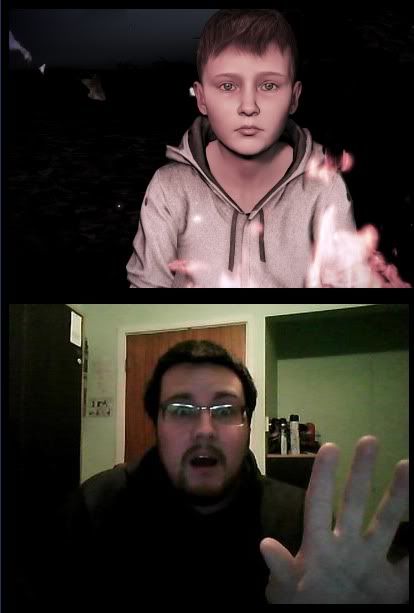
So I've been hearing a lot about the extremely-popular 'Indoctrination Theory' which has been spread amongst fans, and which offers a second interpretation on Mass Effect 3's Linkcontroversial (i.e. bad) ending. I read up on it, and realised that it makes a lot of good points - it suggests that the child Shepard meets in Vancouver and has nightmares about are in fact hallucinations - a common feature of Reaper indoctrination. The theory suggests that Shepard is being indoctrinated throughout the entire third game. It also suggests that Shepard is succesfully indoctrinated at the end, and this is why there is no satisfying, happy ending.

And I thought a lot about this. Seriously. Work and relationships were neglected while I thought about this. It lasted a long time. I liked a lot of what the Indoctrination Theory has to say, and a hated a lot of it too. I think a lot of it is clever observation, and a lot of it is an attempt to make the ending sound better than it is.

So. Here's my opinion. I call it the Partial-Indoctrination theory (and maybe I also come up with a few other things, not related to indoctrination). What I'll do here is explain, piece by piece, in chronological order --- what I think happens in Mass Effect 3. I hope some of it makes you think, because it's pretty damn long and I don't want to waste your time!

Here goes...
(BTW I refer to Shepard as female throughout, mostly to ease my writing because every other character I mention is male.)

----
----

1) Shepard is on Earh and the Reapers finally make their move on the Galaxy, starting with the homeworld of their big thorn-in-the-side. Shepard flees, but sees a child and fails to save him.

I suggest that the child MAY be a hallucination (BioWare probably deliberately left this open to interpretation but did intend you to consider it). People have pointed out that during the prologue neither Anderson nor the soldiers seem to acknowledge the kid visually, and that's too big to ignore or just call 'bad writing'. So it's very possible (but probably left ambiguous delierately) that the kid is a ghost-like hallucination such as Indoctrination victims have mentioned.
Through the guilt the Reapers (or the Catalyst) makes Shepard feel about Earth, using the kid as their avatar, they attempt to weaken Shep's efforts to rally the armies and build the Crucible.
It seems suspiscious to me that Shepard is troubled by the kid, no matter what personality you play and despite all the other people she has killed, e.g. on Torfan - I think the fact that this kid bothers Shep so much makes it very likely that this is an indoctrination attempt. If the kid is a real kid, then the dreams may very well be Reaper influence.

2) The main action of the game goes on -- Shepard and her various allies build the Crucible (a deliberately named symbol of co-operation) and an army to defend it. They eventually go to London and fight their way to the Transport Beam (which is just there because BioWare wanted Shepard in a ground battle on Earth). Throughout all her travels, Shepard is troubled by guilt - her nightmare - and if the player chooses, her resolve is weakened by this guilt and responsibility. Then Harbinger shoots a big laser.

3) Shepard is genuinely shot by Harbinger, and the fact that Harbinger leaves is just bad writing (I guess he thinks Shep is dead and he wants to join the space battle.) BUT as she gets up, she hallucinates more ghostly presences - the trees around her, like in her dream. She is not consciously aware of these due to the shock, but subconsciously she is associating the present situation with the inevitable failure of her recurring nightmare. The Illusive Man or the Reapers (both just tools for the Catalyst) or maybe the Catalyst himself is trying to corrupt Shep the same way he corrupted Saren and Illusive Man. By making them give up and become tools.

4) Shepard struggles on, like the super badass that she is, pulling all of her strength of will together. After she gets far enough, the Illusive Man (thoroughly indoctrinated himself long ago) tries to 'break' her mentally and then physically. He/they/TIM/whoever gets Shepard to shoot Anderson, and almost to 'give in'. But Shepard kills TIM and by doing so breaks the Indoctrination attempt, proving herself too strong to be beaten like this. At this point, the game is won. The indoctrination is broken - perhaps unfortunately for the ending! (At this point, I think the Indoctrination Theory starts to make things up to justify itself and soften the blow of the ending.)

5) Anderson dies in a moment of superbly handled drama and Buch cries like a little girl.

6) Shep's radio goes off (just bad writing I think) and tells her that the Crucible, despite being ready, is not firing. It needs to be fired manually. She crawls up to the Catalyst's viewing platform and meets 'the Catalyst'. He is an AI who built and commands the Reapers. The hardware that supports him is the Citadel and the Relays. He uses the VI-esque hologram form of the kid from Vancouver - - this makes him appear vulnerable and child-like, thus a more sympathetic character - - and it also suggests that he was the kid all along. Again, that is probably intentionally ambiguous.

7) The Catalyst explains (badly - rushed editing) that he is essentially the winner of a synthetic/organic war that pre-dates the Reapers. He won and chose to control organics by killing them with giant robots and guiding them with Mass Relays / the Citadel - there would never be another massive war because he would keep one side down and te other side docile. This is his naiive, childlike understanding of 'peace'. In a way, as the survivor and 'commander' who ended the conflict and watched over the new order, he is 'another Shepard' - an opposite to the character. Shepard, the hero, has now ascended to this level of importance and power. She has defeated a special agent (Saren), a mastermind (TIM) and now the most powerful and successful being who had ever lived (the Catalyst). She is a big hero.

8) The Catalyst admits that via the combined efforts of every civilisation since his 'solution' and via Shepard as a figurehead, his 'solution' has been beaten. You have won. All you need to do is choose how you destroy him (and by him I mean all his hardware - the Citadel and the Relays).

9) The Crucible (provided you built it effectively enough and it was not damaged -- the game's slightly crappy way of justifying the war assets) offers three ways to destroy the Catalyst. Whoever designed it was obviously very thoughtful and non-prescriptive.

RED is destruction, and it is ruthless revenge. Shepard destroys the Catalyst, his creations the Reapers, and all other synthetics, including EDI and the Geth. Shepard becomes very much the Catalyst's opposite, because she has solved the problem the same way he did - keep knocking the synthetics down -- reaping them -- before they get too big. This is the renegade option since it operates on punishing the Reapers, geth and EDI - these are the new Promethean figures, punished for stealing fire. And Shepard is the vengeful god, just like the Catalyst was. But she has a chance to survive.

BLUE is control, and sacrifice. Shepard destroys the Catalyst, commands the Reapers and in doing so takes them away from the Milky Way galaxy forever.... and honestly I'm not sure what happens to EDI and the Geth. But Shepard is another kind of god now - one who removes the Reapers but allows things to go on without her. The united civilisations of the galaxy can rebuild in peace. This is the paragon choice and she cannot survive it.

GREEN is synthesis, and this is the choice BioWare wanted you to pick, hence they didn't really bother differentiating the other two options from it. Shepard destroys the Catalyst, pulls the Reapers out of the Galaxy, and for the first time in history finds a NEW solution to the synthetic/organic conflict -- merges them. Robots are now partly flesh and organics are now partly robotic: just like Shepard and EDI became more and more like their opposite faction, so does everybody. There is a new hope for peace in this new world, symbolised by an Adam and Eve image. After aeons of war between robots and their creators, after so many heroes chose between 'red' and 'blue' actions - finally there is a middle way. This is a flimsy, rushed bit of writing... but it's a nice idea. I think the other two endings were afterthoughts, because the writers were so happy with this one.

YELLOW is the colour of the Jedi Sentinel, but that's another story.

10) Shepard's final act is to manually activate the Crucible. It fires. We see the Reapers die or leave, we see the battle end. WE THEN SEE THE CITADEL ABOUT TO FIRE, AND NOTE THAT THERE IS NO SPACE TRAFFIC - only debris or dead Reapers. I believe that this is bad editing - a stretch of time has occured and the fleets have all returned home, contrary to popular belief among fans.
Presumably also, the Normandy has picked-up all of its crewmen - except Shepard whose body has not been found (I can only assume it was flung to Earth when the Citadel blew). AFTER (I think) THE FLEETS LEAVE, the green/red/blue space-stuff shoots out, destroying every last piece of the Catalyst and his solution. Unfortunately for the fans, this also destroys interstellar travel. I really doubt that the exploding Relays destroy the planets nearby - that is not implied, and it would be ridiculously 'dark'.

11) Inexplicably (perhaps BioWare were planning a sequel or some DLC, perhaps they ran out of time, perhaps they are simply idiots) there is no triumphant montage sequence where we see the fleets return home, and our squad-mates complete their story-arcs. Instead, the Normandy crew are sacrificed to the Adam and Eve metaphor, which by this point is starting to seem less inspiring, isn't it? The Normandy is hit by the green/blue/red space magic and crashes - thanks to Joker's skills - on a pretty planet. note that the planet is green. I really don't think the blue and red endings were supposed to include this, but who knows.

12) The end. An aeons-long war is won, thanks to the amazing and sexy Commander Shepard. She resisted Indoctrination, gathered an army and a piece of technology built from every species who the Catalyst ever oppressed, and saved the day. Unfortunately the Relays are destroyed and the Normandy crew are stranded on some planet -- both of which plot points the writers mistakenly believe to be 'hopeful' and 'dramatic', whereas they are in fact the videogame narrative equivalent of being punched in the balls. They see 'a surprising twist and a brave new world', we see 'a rushed ending with no closure and little explanation'. I think it's a bit of both.

12 1/2) if you picked the Red ending, Shepard's body, lying in a pile of rubble, draws breath. EDI and the Geth are dead and you took revenge rather than control or a new way --- but you may live to build that house on Rannoch.

13) Ages later, a sweet old man with a familiar voice tells a story to his grand-daughter, which involves several inter-species lesbian sex scenes and a lot of gunshot wounds. He is no longer allowed to see his grand-children.

-----
-----

And that's my theory! What about it, huh? Let me know your thoughts, if you got this far.

Tuesday, March 20, 2012

Hear Me Out - Mass Effect 3: The Indoctrination Theory


I started a second playthrough of Mass Effect 3 a couple days after finishing the game the first time. It took a while for me to work up to it, because I was still wrestling with how the ending turned out. As is (was) my process, I beat the game with my first Paragon MaleShep, and then proceeded to make my Renegade FemShep. Figured it would be a good way to hit all the opposite choices, and since you really don't have many more than two choices at any given time these days, it'll probably be easier than in the other two games.

But anyway, it's been rather tough getting through the game. It's still beautiful, well-written, and the combat is still enjoyable, fluid. But... that ending. A lot of people are probably thinking that detractors of the ending are making a mountain out of a molehill, but that thing really was pretty bad. Or maybe it was just okay. Either way, we shouldn't be saying that about the final minute of the Mass Effect Trilogy. It deserved better than what we got.

The story - not us - deserved better.

So, it's been tough to play with that ending constantly sitting at the back of my mind. If there's no payoff to any of our efforts, then what are we even doing here? On Mars?

But a bunch of steadfast theorists have been going back through the whole trilogy, trying to make sense of the ending. To my surprise, they actually may have done just that. Actually, not only do they forge some sense from the very nonsensical ending, but they actually do the same for many of the seemingly random or idle moments of Mass Effect 3. It's called the "Indoctrination Theory" at this point, and if you want a full, point-by-point explanation of what they've figured out, you need only to go HERE.

In brief, the Indoctrination Theory postulates that, over the course of the game, Shepard is slowly being indoctrinated by the Reapers - the effects of which take the form of the young boy that only Shepard seems to see, along with the strange nightmares and that humming noise that follows you around. When Shepard is struck by Harbinger's space laser near the ending, the indoctrination process intensifies and goes into "finalization", manifesting itself in Shepard's unconscious mind as a moral dilemma between him/herself, Anderson (Paragon/Willpower), and The Illusive Man (Renegade/Indoctrination). When Shepard makes it through this internal struggle, s/he encounters the Reapers' final, desperate attempt at indoctrination: the Starchild and those three silly choices.

Supposedly, the trick here is that the Reapers are actually breaking the fourth wall, disguising the Paragon option in red, the Renegade option in blue, and the manifestation of the Reapers' ultimate goal as the pillar of light at the end of the middle way.

At its core, this idea is genius. What better way to demonstrate indoctrination than to manipulate the player into choosing in favor of the Reapers' plan... which is exactly what I did! But I think if this was BioWare's plan all along, something was lost in translation. Either that, or I'm not very perceptive, which must be stated. For as clearly outlined as the Indoctrination Theory is, and for as many hints as there are throughout the game, I didn't pick up on any of it.

But I do have other hangups with the whole idea. Not necessarily with what gamers have brought forth, but the fact that if this theory is true... then we might be worse off than when we thought we were interacting with a God Child.

1. Still No Ending - "Only the Devs See the End of the War"

If we assume that the Indoctrination Theory is true, and the final fifteen-or-so minutes of the game really revolve around Shepard's internal struggle to resist the Reapers' suggestions, then we really haven't seen how the war ended. We cut to black with the war still raging, with Shepard taking his first breaths free of indoctrination, with the fates of the Normandy, your party members, and the rest of the fleet still up in the air. Now, instead of some really confusing sense of closure, we get no closure at all.

BioWare thought they were being clever by only giving players who pick the "Destroy" option with a certain EMS level the super secret ending that shows Shepard waking up on Earth. Clever, but at a weird time. Why not make that part of the actual game instead of some Halo 3-like reward for beating the game on Legendary? Imagine how cool, and how impactful the ending would've been if you picked the right option, woke up back on Earth, and picked yourself up just in time to finish the fight.

If the entire series had been making it a little more obvious that Shepard was fighting indoctrination, then that would be a whole other argument. But he kinda wasn't, not until ME2: Arrival. So to do this during the last game is a little odd, and to suddenly make it the main theme is equally odd. (Not to mention this theory practically requires that you play Arrival to make sense out of this.)

But, to get back on point, no closure at all with the Indoctrination Theory. Here's a list of things that are left blowing in the wind:

- The fates of your party members.

- The fate of the Normandy and her crew.

- The purpose/function of the Crucible/Catalyst/Conduit.

- What happened to the Hammer Strike Force?

- What happened to The Illusive Man? Did his plan ever come to fruition in any form?

- What really happened to Anderson? Coats?

- What happened to Sword Fleet? Hackett?

- Discounting the Stargazer scene post-credits: Did the galactic forces beat the Reapers? If so, how? What kind of casualties did they take in the process?

- What was the point in drumming up Aria's plan to take back Omega? Did she? Will she?

- The "Dark Matter" ending was hinted at heavily in ME2 by way of the hasty creation of the Human Reaper. Is that still a factor?

The list could go on for a bit. Since this was supposed to be the definitive ending, and any potential sequels would very likely take place before the end of Mass Effect 3 and not after, there are a lot of things that weren't resolved. The Indoctrination Theory, if true, was basically BioWare's way of saying: "We'll get around to explaining all of that... later... maybe..."

2. It Wasn't Obvious Enough - "The Hints Are Too Damn Subtle."

A lot of the hints that are supposedly dropped throughout the game that would, in turn, make the case for the Indoctrination Theory are too damn subtle. If it's true, that is. There are simply too few, and they can easily be dismissed as something else entirely. Now, again, I wasn't up to speed on the intricacies of the indoctrination process, so I was at a disadvantage. But I can't imagine a great majority of the ME players were well-informed on that, either.

Shepard's nightmares? I took them as exactly that: nightmares. That kid he saw die back on Earth seemed to represent everyone that he couldn't save - wouldn't save. After you see the kid for the first time in the vents, the conversation you have with Anderson goes over as much. You're on a mission to save Earth, as well as the rest of the galaxy. In the meantime, people are dying by the millions in the background. This seems to constantly be on Shepard's mind, wearing him down.

The theory claims that this is part of the indoctrination process, but I just thought it was Shepard being human.

There are a bunch of other little hints in the audio department if you pay close attention, which I wasn't. (Earth being attacked, and all.) Like when the kid "disappears" in the vent, you can hear the sound of a Reaper. I just thought that since, you know, there were a bunch of Reapers tearing stuff up just outside that they were what I was hearing. It all got lost in the white noise.

Another one: Shepard bleeding from the same spot where he'd just shot Anderson during the final confrontation with TIM. How I wrote it off: Shepard had just taken a direct hit from a space laser, and this was a newly-opened wound, showing that he didn't have much time left. There was also the whole thing about some of the trees and shrubs that were so prevalent in Shepard's nightmares showing up after his run-in with Harbinger. But to be blunt: that part of the game was a graphical shit-hole. Those trees and shrubs (there were only a few) share a scene with THIS.

Those weird, multi-colored piles are supposed to be bodies, but obviously look nothing like what they're supposed to. This is what I'm trying to get at here. With the waxing and waning quality of the game, with the frenetic pace, the throwaway lines that could easily be mistaken for other things... Mass Effect 3 makes it real easy for people to completely miss these allusions to the indoctrination process. I had to watch two detailed videos, read a lengthy article and a codex entry before I "got it".


"Mother of God..."

So, in what sense is that a successful ending if the entire point of it, and the hints that lead up to and reinforce it, are weak enough to be missed entirely?

3. 11th Hour Creativity - "Great, kid! Don't get cocky!"

If you have another half-hour to kill in the name of seeing how utterly the current ending of Mass Effect 3 fails, I defer to this fellow's fine breakdown of how the ending messed up, and how it could've been so much better.

In the video, he makes a great point that has pretty much permanently tainted my view of Mass Effect 3. That this wasn't just the ending of one game; it was the ending of the entire trilogy! And as the ending of a video game trilogy that many have sunk over a hundred hours into over the course of five years, you'd expect some semblance of closure - though I personally expected A LOT of closure! Even ambiguous closure!

Given that rather extensive list of yet-to-be-closed plotlines I listed above, it seems very tragic to me that BioWare would take this opportunity to take the story in some risky, divergent direction that ultimately, regardless of I.T.'s perceived truthiness, stands at odds with the rest of the series. The whole thing is very reminiscent of Battlestar Galactica's fierce commitment to making random philosophical statements in an attempt to be unpredictable and "memorable". Who would have thought that a show about humans fighting robots would turn into a statement on domestic terrorism, singularity, the purpose of a soul, and the origin of God?

Writers trying to stay ahead of their fans has been an odd sort of trend in the media these days, though there is something to be said for "the only thing worse than not getting what you want, is getting it." And that eventually delves into artistic freedom, and how maybe if BioWare is satisfied with how everything turned out, we should be satisfied.

I don't know about all that. I can only critique what I saw, and what I saw was a bunch of artists trying to get overly creative at the last possible second. If it was for our benefit or for their personal satisfaction, again, I don't know. But if you take a series that's been building towards this endgame between the Reapers and the Galaxy, then something tells me that throwing a curveball in the form of Shepard resisting indoctrination that ends with the credits rolling... isn't going to be seen as satisfactory. Maybe if this was the first game. Maybe if BioWare hadn't been teasing at something so specific for three games in a row, all of this would've been taken in the right light.

Oh, not to mention that a satisfying ending would've compelled more people to play through the entire series again to see how everything would pan out in different ways. There will probably be some who still do this, but not nearly as many as there would've been.

All this to say, an "Indoctrination Ending" is not really what everyone initially signed up for. This is just my opinion: it's really not how I ever expected the series to go out. Although, maybe that's exactly what BioWare wanted.

4. End Result - "The only winning move is not to play."

If the Indoctrination Theory is true - which, again, I'm almost certain it is - then this really means a lot for the state of the Mass Effect series: past, present, and future. What BioWare have done here is, more or less, hacked off the real ending of the game. Remember when Neo briefly died near the end of The Matrix? If the movie had ended there, people would've been a little confused and frustrated. But, in this case, BioWare has all the motive to take that ending and dangle it in front of their players.

Would they actually do that? Maybe. They've already sold us the last living Prothean, the end of the Shadow Broker story arc, and the prologue to Mass Effect 3. It's also possible that the ending they wanted to provide simply couldn't be accomplished within their timeframe. The game was already delayed once, after all. A lot of things could've happened. Or it could be much, much less complicated than we're making it out to be.

I really hope this isn't the case. Until the ending, Mass Effect 3 was a fantastic game and one of BioWare's best. It would be a shame to think they'd willingly slice-'n'-dice a quality product like this to sell more DLC.


Sources: