From Central California and Northern England, two aspiring writers natter and share a blog. We like to talk about our disparate but oh-so-similar lives, offer opinions on literature and movies... and endlessly reminisce about Bioware RPG's.


We hope you haven't had enough of our disingenuous assertions. If you have, please don't hit us.
Showing posts with label holy fraking shit. Show all posts

Monday, August 22, 2011

Game Review: Dead Space 2

Typical outcome: "It's beautifu-OH SHI-!"

It's like being asked if you want to be bit by a rattlesnake a second time: Hey, wanna go up against the necromorphs again? Huh? Do ya? Rawr?

But by the time my copy of Dead Space 2 came in the mail, I was psyched beyond any semblance of a care. I thankfully knew very little about the story, or even what to expect. I knew my mom probably wouldn't like the game very much, but, then again, she's the one who introduced me to The Thing. I was very excited going into this game, with expectations that sat pretty high up there. It would've been very easy for Visceral Games to just rehash the first game (like BioWare, they're a subsidiary of EA), but I was amazed that DS2 pretty much met all of them, and did so with style.

The game's story picks up some three years after the quagmire on the Ishimura, with Isaac Clarke waking up in the psych ward of a hospital, confused and suffering from a severe bout of trauma-induced amnesia. He remembers absolutely nothing since escaping from the Aegis System, but he does remember just enough for him to recognize a necromorph infestation when he sees it. Things just never get better for good ol' Issac.

Barely escaping with his life, Isaac is thrown into absolute chaos, with no other real objective except to survive. As he soon discovers, the place he's currently running around is "The Sprawl": a massive, self-contained city built around a shard of Titan, one of Saturn's presently-pulverized moons. Things are gradually going from bad to superbad, as the necromorph infestation spreads violently throughout the unsuspecting populace. He (and by extension, you) has no idea how the necromorphs appeared here or how to even go about stopping it. Eventually, he comes into contact with several other characters, who shed some light on a conspiracy at the heart of it all, and inform Isaac Clarke of just how f**ked he is.

Without giving too much away, I absolutely loved how the story unfolded in Dead Space 2. Much like its predecessor, it's a slow process of gathering information and just taking a look around, but unlike DS1, this game doesn't even tell you where you are, or why you've woken up in a straight-jacket! It's reminiscent of the mansion from Resident Evil; you're just there, bad things are happening, and it takes some time to figure out what due to the horrible, horrible circumstances. There's a palpable sense of wandering in ignorance at the worst possible place, at the worst possible time - minus the Jill sandwich.

As for the location you wander in ignorance, the Sprawl is pretty much the opposite of the USG Ishimura, in that there are less winding corridors, more open locations (comparable to the Ishimura's bridge area), and many more pretty things to look at. Dead Space was a visually stunning game to me, especially considering that it's just about three years old. Even on the Xbox 360 version, Dead Space 2 looks even better. Everything looks cleaner, the use of light to create mood and tension has been employed more frequently, and the level-design is fantastic.

As before, there are no real loading screens or "cutscenes" in Dead Space 2, only strategically-placed elevators or story moments to distract you from when the game's actually doing its work. The camera never cuts away for the entire game (unless you die), so when shit goes down, it's very unexpected. This also makes the Sprawl feel as massive as it looks, since the entire city was actually designed around the areas you can explore (much like Alan Wake and Mirror's Edge). It feels like a real spacestation, and that's the important part. There are apartment complexes, shopping malls, food courts, a church, sewers, and other spoiler-ific places that you'll be fighting your way through. Some care clearly went into the design of this game if they designed a whole city even though you only play through certain parts.


Click to see just how massive the Sprawl appears.

Overkill? Perhaps, but it makes the experience. (It's an eight hour game spread across two discs, which should give you an idea of how dense this game is!)

So, it's bigger, prettier, and the story expands upon the main plot and the lore in all the right places. But is it fun to play? Well, Visceral Games have clearly charged ahead here with that old mantra in mind: "If it ain't broke, don't fix it." There are many gameplay tweaks that rectify the major hangups that most people had with the first game. The zero gravity sections now allow you to float around them using thrusters, instead of a point-and-click bounce from one room to the other. Isaac is also a little more maneuverable, where he was previously kinda sluggish, which makes a big difference during an attack.

The return of "context-sensitive events" that pop up every now and then was very welcomed. Nothing breaks up expectations like being suddenly flung through space, forced to maneuver your way through debris along the way. They're almost like unique mini-games that you only play once, much like the drag tentacles from DS1. More of that is always nice.

But aside from tweaks and the token addition of weapons and new brands of necromorphs (terrifying, though they are), the gameplay remains largely unchanged from the last game. For better or worse, you're still dismembering necromorphs for eight hours, which gets noticeably repetitive this time through. This wasn't much of a problem in the last game, since getting acquainted with "dismemberment combat" and the necromorphs themselves was half the fun. Not to mention the encounters were more infrequent and set up with a greater sense of subtlety, which just built more tension. This time, you just get swarmed. Every time you feel like you're gonna get swarmed or attacked, you do. Lots of swarming going on.

It would be the equivalent of picking up Mass Effect 2 or Dragon Age 2 for the first time and discovering that geth/darkspawn are the prime enemy again, and you're gonna be fighting them exclusively for the whole game again. When it comes to the combat, there's a lot of deja vu going on, and I'm worried that Visceral Games are beginning to back themselves into a corner in that regard. I didn't care for Gears of War 2 because you were just fighting more of the Locust Horde, and I don't much care for Halo because in this rich sci-fi universe Bungie created, the Covenant and their various sects are apparently the only threat to a supersoldier in the entire galaxy.

Variety is the spice of life, Visceral, and making a variety of one type of enemy isn't gonna cut it for Dead Space 3, because it almost didn't work with Dead Space 2. The necromorphs are scary as hell, but so were the zombies in Resident Evil, and you can see what repetition did to those guys. Dead Space 3 needs to be your Resident Evil 4, where you go back to the drawing board and make with the "outside the box" stuff.

So, I guess my main gripe with the game isn't necessarily with the game itself, but with the direction of the franchise overall. You can just see Dead Space there, with its sci-fi universe that I'd seriously rank up there creativity-wise with BioWare's Mass Effect series, teetering on the edge of becoming a series about shooting different kinds of necromorphs in slightly different ways. Once you get swarmed for the billionth time, the scares and the immersion goes away. The opening? That was terrifying. The school? Nightmare-inducing. Getting swarmed again outside the factory? Annoying.

But it says a lot about the general atmosphere, art direction, and story of this game that I'm willing to shoot my way through even more swarms just to play through it again (having New Game+ available doesn't hurt either). It may not do anything particularly daring gameplay-wise, but everything else tries to do what Dead Space did great, and do them even better. In my mind, they succeeded, and they've definitely made a fan out of me. Dead Space 2 is still an amazing, terrifying, and immersive experience worthy of the hard sci-fi genre that it celebrates. If you loved the first game, there should be very little dissuading you from trying out its sequel.

It's a beautiful game, and your mom will hate it.

Sunday, August 14, 2011

(Tardy) Game Review: Dead Space


My first experience with the survival/horror genre was Resident Evil 2 on the original Playstation. My family had gone out to a friend's ranch in the middle of nowhere. It was full dark, we were surrounded by orchards, old machinery, and there were coyotes yapping in the distance. Probably my first, intense feeling of isolation, and it was at that magical moment that our friend's son asked me, "Hey, do you want to play some Playstation?" I could not refuse. This was back when the Playstation was this magical, disc-using wonder of a game system. I loved just watching the thing work.

So, he puts in Resident Evil 2. By the time we get past the first cutscene, I'm already going pale. I had no concept of zombies at that time either, so this was all a great shock to me. Then the game starts going, and Leon Kennedy is desperately pumping round after round into things that die... and then they don't? I never even got to play (the guy was one of those gamers: "Hey, lemme show you something real quick."), but even so, I was terrified. Don't even get me started on how badly those zombies breaking into that gun store scarred me (hint, hint: probably scarred for life). Nowhere was safe!

Then someone suggested Silent Hill and I remember very little after that.

Anyway, my gaming origins, so to speak, are rooted in survival/horror. Since that night, instead of flinching away from any other games of that type from Capcom and others, I ran toward them. I don't know why I did that. Maybe after a scare that bad, it's like a "hair of the dog" kind of thing. As the years went on, I'm not sure if the games stopped being scary, or if nothing had reached that RE2 level of scary since. Resident Evil 4 was the last real freaky-ass game I've played. There's been Bioshock and Amnesia: The Dark Descent, but neither of those scared me in the least. I don't even remember jumping.

That's where Dead Space comes in. I had bought it during a Steam sale without really thinking too hard about it. (The game was $5 at the time.) I played the first level, and while it hooked me, I was still getting acquainted with playing games on the PC. This was back when I had just picked up my new comp components, and could suddenly play games of a higher graphical quality than Minesweeper.

The other day, I picked it up again (with the intention of finishing a game so I could clear it off my hard drive), and was suddenly really taken by it. The atmosphere, the story, the gameplay, the macabre and grotesque antagonists: it all sorta clicked. I couldn't put the game down, and ended up finishing it that night. Let me tell you, playing at night was a bad idea.

For the yet-to-be-initiated, Dead Space is a survival/horror game that takes place in spaaaaace. A massive, sub-orbital mining vessel (also known as a "planet cracker") called the U.S.G. Ishimura has recently gone dark, and a distress signal is sent out. The corporation that owns the ship tasks Isaac Clarke, a space-engineer (Space Mario), and his team with figuring out what's gone wrong on the Ishimura, and to fix the problem if possible. After a hard landing, the rescue team finds that the ship appears abandoned. This doesn't last too long, though, as they're soon attacked by the gruesome, mutated creatures informally named "necromorphs."

The whole of Ishimura's crew have been mutated into decidedly inhuman beings, and they don't have a fondness for anything that isn't dead. So, Issac and the rescue team have to figure out a way to get off the planet cracker, stop the necromorphs from infecting other planets (mainly Earth), all the while attempting to look for survivors. Issac's girlfriend, Nicole, was also a member of the crew, so he also has to deal with that along the way - on top of everything else.

All right: the necromorphs. It's clear that this game was primarily inspired by John Carpenter's The Thing, and this is a very good thing (hehe). The monsters you fight are not only painfully scary, they're downright disturbing. You might spend moments of your fights with them just reconciling what they were with what they are. Much like Gabriel Iglesias' "Six Levels of Fatness," there are Six Levels of Scary in this game:

1. Creepy
2. Freaky
3. Frightening
4. Disturbing

Sometimes I'd die because I was so distracted by the design of these things, looking on in horror as they approached. Dealing with that is just one part of the game, though. Let's not forget that you're in outer space, and the developers have gone all out to ensure that they take advantage of this. You'll be playing engineer a lot (maybe more than some would like), and fighting things like rogue asteroids, orbit decay, and zero gravity in order to get yourself the hell outta Dodge.

And this is what I really liked about Dead Space. All of your missions, for better or worse, are always sci-fi oriented. Go restore gravity to this deck, take a walk outside before a meteor shower tears you to shreds, play some zero-g basketball to retrieve a nav card (yes, this is an option), learn about the future's most prevalent religion: Unitology. All of this makes your stay aboard the Ishimura a very immersive one. You get a really good feel of how the crew operated aboard the vessel, humanity's economy, technology, social structure. It's a nice, clean(ish) cross-section of a very well thought-out science fictional future in store for humankind.

This isn't a straight-up gorefest. Clearly a lot of thought was put into making the ship and the society that clings to the stars around it feel very logical. That's the key to good science fiction and good horror. Things just flat out make sense. You'll spend very little time questioning the science of this or the logic of that.

If there is one thing that this game suffers from, it's the "Oh! Just one more thing!" syndrome that some games suffer from. This can make the game feel very frustrating at times. Yes, you've just spent an hour fixing the shuttle: Oh! Just one more thing! It seems someone removed the navigational system from it, so I guess you'll have to find it. Yes, you've just spent an hour getting the Ishimura's engine's back online: Oh! Just one more thing! It seems we're passing through an asteroid field now, so you'd better get the defensive countermeasures up and running before we do anything else.

It feels very much like Alan Wake or Dragon Age 2 when they're at their worst (which, for DA2, is all the time - hiyooo!). It can never just be over and done with. One more thing has to go wrong so you'll spend more time running around the ship from hell. Dead Space is fantastic, but the Writer of Subtle Plotlines over at Visceral Games seems to take a vacation at random times. Still, even then, some of these little sidequests take you to some amazing places. So while I don't applaud how they get you there, I'm glad that they get you there, if that makes any sense. It's like being driven to an arcade in a Ford Pinto.

And I just have to say that the visuals are dazzling. For a three-year-old game, there were several moments where I just had to stand and stare for a while. Remember that one really great moment in Mass Effect 2, when you step into the exposed CIC of the Normandy as it's getting torn apart by the Collector vessel? There are several just like that.

Sometimes it's a blessing: playing a game so late in its life cycle. Because now I've played a game that I truly love, and I don't have to wait any time at all to play the sequel! Dead Space is just a fantastic game. No, it's not perfect, but it's original where it counts. Much like Mirror's Edge, you just don't expect games like this to come around every dynasty. Dead Space is a violent, shocking, disturbing, thought-provoking game that's damn fun to play. The immersion factor is high, the sci-fi is mostly on par with Mass Effect, and it'll probably scare the hell out of you.

If you haven't played it, give it a try! Again, like Mirror's Edge, you could probably pick it up for $10 easy. You could do worse!

Tuesday, July 5, 2011

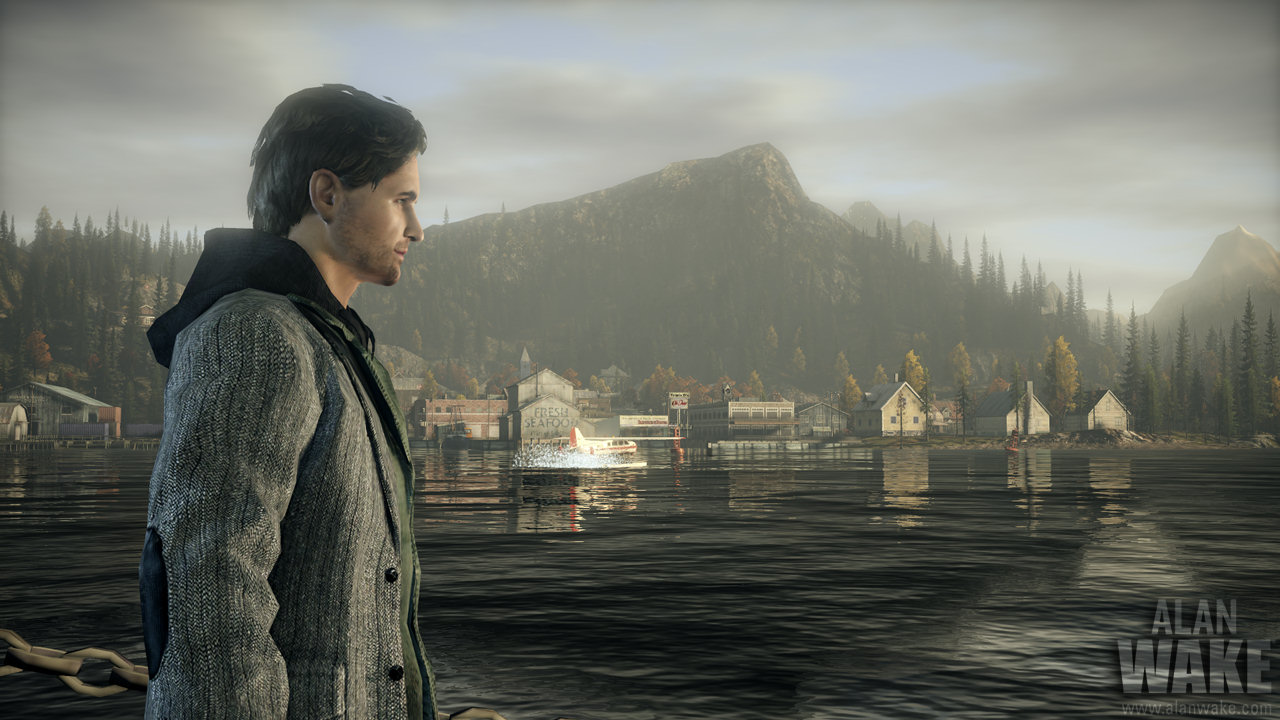
Game Review: Alan Wake


Alan Wake opens with a nightmare, with the eponymous main character making his way through a forest that has been taken by darkness. Streetlights break as you approach, a dark mist stirs overhead, and a faceless man with a rather large sickle has taken it upon himself to kill you. In turn, you will kill him several times over. Your goal is to reach a lighthouse burning brightly in the distance, but the man, one of the Taken, will not make that journey easy for you.

The closer you get to the lighthouse, the more violent the darkness becomes. Vehicles are ripped from the ground and tossed violently in your direction. The bridge you have to cross collapses into the waters below. Only steps away from the lighthouse, you are nearly overtaken by a spiraling torrent of debris and howling darkness. You are safe in the light, and leaving it will instantly invite death.

This is the tutorial.

Free from the nightmare, Alan Wake finds himself back in reality with his wife, the both of them on a ferry that's slowly drifting toward the town of Bright Falls, a secluded and sleepy little place somewhere in the state of Washington. Alan Wake is a bestselling novelist, and it's been a couple years since he's been able to write anything remotely productive. Hoping a vacation in the mountains of the pacific northwest will cure his writers' block, he and his wife rent out a cabin on a lake just outside of town.

Without giving too much away, things start to go south from here. Alan Wake recovers from a blackout and has apparently just crashed his car somewhere in the woods. Not only that, but he can't remember anything from the last seven days. Not only that, but his wife is now missing, and all evidence of their stay in Bright Falls has literally been erased from history. Not only that, but the story - a horror story, as you're quick to find out - of a novel he doesn't remember writing is coming to life in the middle of Bright Falls, destroying, consuming, and killing anything that gets in its path.

In the face of very... unique circumstances, Alan must find some way to recover his memory and find his wife before his story literally takes the world by storm. The road to doing that is paved with plot twists, interesting characters, and villains who cannot be stopped by conventional means. The makings of a great horror novel.

And that's honestly what it is. Alan Wake can be seen as one big celebration of Stephen King's works, with several direct references that his fans will definitely catch. Outside of that, though, is a story that's wholly unique in its own right. The writers of the game did an excellent job here, and I can honestly say the game has some of the best, most competent writing this side of Chris Avellone. The game is a horror story, and it's also an allegory of the writing of a horror story. The amount of work that must have gone into the story to keep it straight with the player seems daunting just thinking about it, and yet it was pulled off with only the slightest of hitches.

It's a story within a story within a story.

But outside that story, there's still a game to be played, and I think this is where Alan Wake rises above a game like L.A. Noire, another story-heavy mystery game. Throughout, you'll be combating the "Dark Presence," an evil force that destroys based on Wake's writings, and represents the nothingness beyond the edge an artist's creation. The Dark Presence possesses the people of Bright Falls, turning them into perversions of the dark called "the Taken." These are who you'll be fighting primarily, using your trusty flashlight to burn away the Dark consuming them, and then your gun to send them back wherever they came from.

The combat doesn't get much more complicated than that. There are puzzles along the way and instances where you'll have to get creative with your various light sources and guns, but I don't think there'll be anyplace where you'll not know where to go. This may seem like it could get repetitive over the course of this 10 - 12 hour game, and sometimes it does, but there are several "saving graces" that make progressing through Alan Wake almost addicting.

The story is constantly prevalent, to the point where it seems that everything you do is progressing it. There is always one more plot twist, or a waypoint in the distance that promises to shed some light on the mystery surrounding Wake and his wife. The level design and world building also contribute to this. The visuals are amazing, and nearly all of the locations are unique from each other. Bright Falls feels like a true American mining town, caught in a tug of war between its colorful history and the influence of the modern world. Though you're usually making your way through the surrounding forest, it always feels like you're on your way to discovering some new facet of the area.

It's interesting! If I wasn't playing it to see what new location the game would throw at me, it was to progress the story; if it wasn't to progress the story, it was to send a few more baddies back into the Dark; if it wasn't to fight some baddies, it was to poke around to find some hidden areas. The town also has lore of its own, so you could also run around and check out signs to expand your "codex" Mass Effect-style.

To recap, let's list what's great about this game:
-The story/writing.
-The soundtrack. (There are also some musical interludes between chapters that fit the mood perfectly.)
-World-building. (I live just south of Washington. This game is scary-faithful to how a western town should be.)
-Great characters.
-Only a few loading screens, and they're between chapters! (And after you die...)

Let's try to get critical here. I think I already pointed out that combat can get repetitive at certain times, and definitely during the last chapter. There were also times when I thought the combat got in the way of the story or seemed too obligatory, like the developers felt they had to throw more monsters at you - but I think that's just a testament to how good the writing is.

Also, it was a little surprising to see how much detail went into everything except the lip-syncing. It's pretty bad. The characters just can't seem to move their mouth along with the words they're speaking at times, and it can get a little distracting (especially when the drama ramps up). You get used to it, but it's just one of those things.

One last thing (though this is just wishful thinking instead of a criticism), the game just begs to be an open world/sandbox title, and I'm kinda flabbergasted that it isn't. You can drive in one direction for fifteen minutes without hitting a load screen, but you cannot leave the road (unless it's been destroyed). Along the way, you can clearly see how much work went into making Bright Falls and the surrounding forest and mountain range look unique, but there's no real way to explore any of it. Though, there are a ton of nooks and crannies to seek out, it'll feel like you're walking the railroad through New Austin in Red Dead Redemption with no way to jump off. It can be frustrating, but I suppose the pacing and the story impact might have been affected otherwise.

I guess we'll never know.

In any case, Alan Wake is definitely one of the best games I've played this year. I was in a constant state of awe and amazement at the amount of surprises the world and the story were able to throw at me without getting stale and predictable. Being genuinely frightening at times didn't hurt things either. This is just a great game, and for the price it's being sold for these days... you could definitely do worse.

Thursday, January 20, 2011

Red Dwarf back from the dead (Have you been trying to explain about our future selves again, sir?)


Hello? Testin', one two three. Hello?

Ye-es!

--


Red Dwarf
is something I discovered in high school, and then obsessed over, in the truest sense of the word, for the next eight or nine years.

Someone (who coincidentally I haven't seen since high school) just sent me this link - they're making a new series of Red Dwarf! Like, right now they're making it. As I type this, Robert Llewelyn is probably having his mask removed and complaining about it, wondering if his complaints are amusing enough to justify another book.

This is very interesting to me! Imagine if the news said, "Lucas unveils third Star Wars trilogy!" or "Turns out there are invisible Dinosaurs! How bout that?" Really interesting. Dwarf is the reason I write, and the standard I aspire to. It shaped my teenage years, my sense of humour, voice and personality. Red Dwarf.

-

But here's the thing. I don't want any more.

It's not just because series 8 was a massive disappointment. And it's not just because last year's special episode, 'Back to Earth' was somehow even worse.

I don't want a Red Dwarf IX because Craig Charles, who plays Lister, is 46. I just read that in the above Daily Mail article.

At the start of the show, Lister was 25 (how old-do-I-look??) and even by series 7 (after many new seasons, reinventions and Craig Charles' unwarranted stay in prison) the guy was only 28 (and I feel a new maturity about myself. In fact, I can't even remember the last time I tried to urinate on Rimmer from the top of D Deck. Oh wait a minute... Friday.)

The credits at the end of the last-broadcast show began with "The end" - to contrast with "The beginning" on the first episode's credits. And though the show claimed it was joking... even then I figured they weren't. Or it was a half-joke. Maybe.

So - for years I waited... and co-creator Doug Naylor toiled to make a movie happen. The plot... sounded pretty bad (the baddies were called 'Homo Sapienoids') but I wanted to see it more than anything. It never happenned, for various reasons.


And then, out of nowhere, after a decade, came the all-new special, Back To Earth. And this was a really wierd experience for me - Knight will attest because I poured my confused feelings out at him several times - because it was bad. My favourite, favourite writer ever, ever had written a bad show (although there were some flashes of real brilliance in the third act).

Worse than that - with the exception of Kochanski, all the characters were old. Like, old old. I don't mean to sound like a sneering teenager, but they were old. Understand that these characters were like friends in my head - dear friends, honestly. And now... Lister was old. Kryten was old! The Cat was old and wrinkled. And Rimmer was old and wrinkled and grey and thinning... and some of them were getting fat.

And they were on Coronation Street for some reason.


I know that so far this entry has been garbled, confusing and quite frankly duller than an in-flight magazine produced by Air Belgium. But I'm getting to my point - here we go now.

--

I don't want Dave Lister to be 46.

At the age of 25 he fell in love with Kristine Z. Kochanski. After that, he got stranded in space after the end of humanity and longed to get back to Earth and to get Kochanski back. He was a disgusting slob who consumed nothing but curry, lager and cigarettes, and it was funny. He spent the next few years still a slob and still in love with Kochanski... but slowly becoming more mature, more romantic. In one of the novels, he was marooned on a planet and grew a field of jasmine in the shape of two K's. At the age of 28, he met Kochanski again and lost Rimmer, the hologram bunkmate he hated, and who existed purely to 'keep him sane'. Rimmer was easily the funniest one, and he had now left the show, becoming a hero in the process. The story was coming to an end, right?


In the Back to Earth special, he was forty-something... still living on Red Dwarf, still a slob in a leather jacket, still pining after Kochanski. Rimmer was losing his hair. And the jokes weren't funny.

I like to pretend 'Back to Earth' didn't happen.

-

Okay, I'm being overly dramatic!

Craig Charles says he refused to settle without a script as good as the golden age of series V and VI. Well. If he's right, I owe the Dwarf people a big apology for this blog (if indeed anyone read this far!) Part of me is very excited about new episodes.

But - a new series as good as the glory days? Or even decent? I don't see it.

It's a comedy about four or five lonely, odd young men (and a perfect woman at one point) alone on a space ship. usually in silly costumes. They shouldn't still be there at 46. They were supposed to be on Fiji by now. Or in the Ganymede Holiday Inn with moustaches. Or repopulating the human race after destroying The Rage. Or something. We weren't supposed to see them getting fat.


Thursday, May 13, 2010

Book Review: Star Wars: Traitor by Matthew Stover

Okay, so I remember when Mister Buch first recommended Star Wars: Shatterpoint to me, and I remember what I was thinking: Star Wars books are obviously a silly concept. I had been talking about Heart of Darkness for some reason when he more or less said, "Hey, you know this one Star Wars book was sorta inspired by Heart of Darkness. Also, I am British." I nodded a bit, confused by such a concept. It actually sounded like a good idea.

I totally impulse-bought the book the next day, I think. Before I started, I was a little uneasy reading about Mace Windu of all people: the Jedi who almost did a lot of things. So, I start reading. The intro of the book drags on. We get a very long Apocalypse Now scene that goes on forever and almost convinces me to put the book down. Such exposition grates on me like some sort of device used for grating cheese...whatever those could be called. (wink)

But! I didn't stop there. I kept going, well into the book, past the part where Mace Windu flips someone off and where he uses his lightsaber to perform brain surgery. I sorta skipped around the giant battle near the end, which took up so much space and had none of the great pacing or development that had taken up every sentence of the past 300 pages, and made my way to the back cover. Wow. That was amazing, I thought. That was like...Wow.

Jedi can do that? STAR WARS can do that?! Was this insane wordsmith, Matthew Stover, allowed to do any of this? Wow.

Star Wars seemed so much deeper, so vibrant, alive. Plausible. No longer was it being communicated to me through rose-colored glasses, through the words of authors who wanted nothing more than to retell a story the way the movies would have, or to show good triumphing over evil, Jedi over Sith, so on. Stover showed me that he could do all of that if he wanted to, but that would be a lie - and the truth.

Basically, shit got real.

I read his novelization of Revenge of the Sith afterward, also by Buch's recommendation, and absolutely adored it. For one, he didn't drag on at all except for two parts, if I remember correctly. The opening battle was very long, but I got into it after awhile, but the second battle over Utapau was daunting as hell. But even with that, I still loved that book. Why? Because I loved Episode III a lot, but it fell just short of my expectations. It's like Stover knew what I wanted out of that movie and wrote the book accordingly. To him, everyone matters. People like Count Dooku aren't evil for the sake of evil, they have motive. Similarly, Anakin's fall makes much more sense this time around; it wasn't just predicated on his love for Padme, it was on account of the expectations that had been thrust upon him, the power that he knew he had, and didn't have. It felt real. I could understand it all, fully.

Also, Palpatine was just an amazing character, as well. He, too, had motive.

After those two, it was awhile before I read another Stover book. I was just in awe. I hadn't been so excited about reading since R.A. Salvatore's Icewind Dale Trilogy or Ender's Game or Foundation. Not only are Stover's books well-written, they have this gravitas about them that makes them properly dramatic. Makes them a proper Space Opera, and almost gives me an image that all of his stories are happening on a stage, complete with a Master of Ceremonies who hops up on stage to set the tone.

Then I read Heroes Die and I sorta stopped caring as much. As I've said, I liked it more for the concept, which was totally up my MMO loving alley. But the thing kept going on and on and on about little, insignificant things. Though there was a good story in there, all the little flaws that were present in his Star Wars books that weren't very noticeable took center stage here. My friend read the book, loved it more than I did, but agreed that the exposition got in the way a lot.

Stover's strength is in his characters and how real they are. And even if you can't sympathize with them, you KNOW who they are. You understand them, and that's where the real drama of his stories come. Like I said, one of the most heartbreaking things I've ever read was seeing Mace Windu realize that all that he's ever been just was not enough to overcome the jungle.

I've had another one of his Star Wars books, Traitor, sitting on my shelf for a long time. The reason for the hesitation: I was still kind of at odd with what I read in Heroes Die and I had promptly forgotten the reasons I loved Stover's books in the first place (not on account of the book, it had just been a long time since I've read them). Also, Traitor is Book 13 in a really long series of books called The New Jedi Order. Who picks up a book so late in the series and starts reading? I do, I guess.

I've read books from the Old Republic and some from the Clone Wars, but I hadn't read any that took place during the New Republic. I was hesitant; I wasn't quite sure how reading about characters I had come to love on screen would work. Thankfully, I didn't need to find out, because this book revolves around a character I had only heard about, never read about: Jacen Solo: twin brother of Jaina, son of Han and Leia Organa Solo. Interesting.

The book, in short, is amazing. Again, it's hard for me to believe that this is actually a Star Wars book. I came to love Jacen Solo as a character and really feel for him as he went through his various tortures, which are crazy to read. The action is top notch and as bloody as Stover was probably allowed to make it. The dialogue is real, witty, and emotional at times. There was one moment where I very nearly teared up, something I'm not sure a book has been able to do to me yet. And even though this is Book 13, I was very rarely lost in what was going on. All that you MUST know is that the New Republic has been fighting an alien race for control of the galaxy: no big surprise there, huh?

This is one of the best books I've ever read. Stuff like this just speaks to me, and I enjoy it when an author like Stover has something to say and not just write. This thing talks about fundamentalism, tradition, the frail divide between good and evil, the true nature of the Force, and how being yourself is paramount to all else in life, and can even land your actions on the list of most epic scenes ever created within the Star Wars universe (which I won't spoil here, and yes, that's a real list).

This book is on my shelf, and there it will stay. I am proud to have read this and infinitely glad that Buch suggested Stover's works to me. Everything he does inspires me in some way: his honesty, tenacity, and his liberal usage of words like fuck and/or shit. He still remains one of my inspirations, and this book has sealed his fate as such.

I'm off to buy the next/last Star Wars book he wrote, Luke Skywalker and the Shadows of Mindor. Reviewers have been tough on him for this entry, but I have a good feeling that it won't disappoint. In any case, I'm really not sure how he could top himself with Traitor. He has two more books coming out this year, both of which I'll list here, both of which I'll be buying.

/end ass-kissing

Star Wars: Traitor
Amazon.com|Amazon.co.uk|Book Depository

God of War (co-authored with Robert E. Vardeman)
Amazon.com|Amazon.co.uk|Book Depository

Test of Metal: A Planeswalker Novel (Magic the Gathering)
Amazon.com|Amazon.co.uk|Book Depository

Monday, March 8, 2010

Knowing Is Half The Battle


Gameinformer.com just posted up a very interesting article about Dragon Age: Origins. This would, of course, be of interest only to those valiant few who simply must know just how many hours of dialogue were recorded or the total word count of the game's script. I would fall into that demographic, and if you do, too, here's the LINK and a quick excerpt:


-Leliana's Song was composed and recorded within 24 hours.

-QA analyst Bruce Venne played 1,957.55 hours of Dragon Age PC in 5,352 games.

-The 44-piece orchestra was recorded twice and melded together to form, in essence, an 88-piece orchestra.

Woooooow... =O